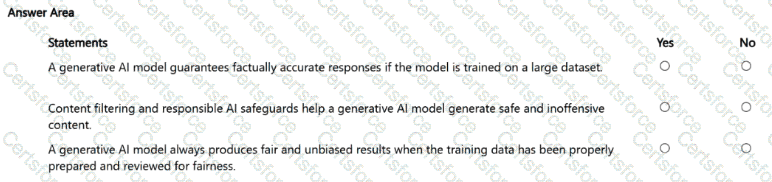
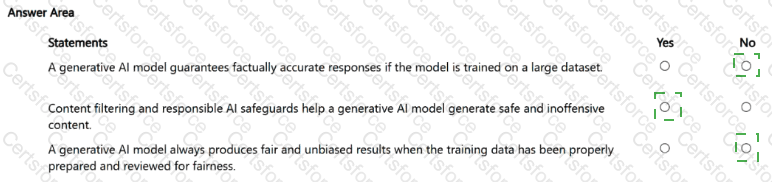
A generative AI model guarantees factually accurate responses if the model is trained on a large dataset. Answer: No
Content filtering and responsible AI safeguards help a generative AI model generate safe and inoffensive content. Answer: Yes
A generative AI model always produces fair and unbiased results when the training data has been properly prepared and reviewed for fairness. Answer: No
No — A larger training dataset can improve coverage and fluency, but it does not guarantee factual accuracy. Generative models can still hallucinate, mix concepts, or produce plausible-but-incorrect statements because they generate likely text rather than verifying truth. This is why solution designs commonly add grounding/retrieval, validation, and human review for high-stakes outputs.
Yes — Content filtering and Responsible AI controls are specifically used to reduce harmful, unsafe, or policy-violating outputs . In practice, safeguards include input/output filters, safety classifiers, and governance controls that help enforce safety policies and minimize offensive content. These controls don’t make outputs “perfect,” but they materially reduce risk and are a standard part of production AI deployments.
No — Even with careful data preparation and fairness reviews, models can still produce biased outcomes due to residual bias in data, label/measurement issues, deployment context, and shifting real-world distributions. “Always fair and unbiased” is an absolute claim that is not achievable in real systems; fairness is managed through continuous evaluation, monitoring, and mitigations—not assumed as guaranteed.
Contribute your Thoughts:
Chosen Answer:
This is a voting comment (?). You can switch to a simple comment. It is better to Upvote an existing comment if you don't have anything to add.


Submit