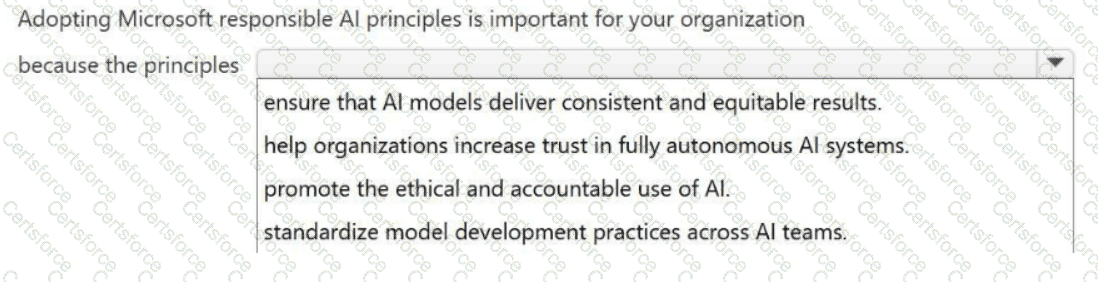
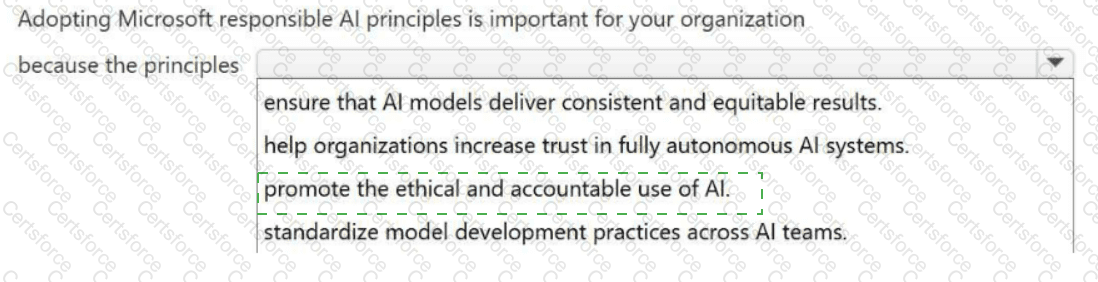
promote the ethical and accountable use of AI.
Microsoft’s Responsible AI principles exist to guide organizations toward trustworthy, ethical, and accountable development and use of AI systems. Among the provided options, “ promote the ethical and accountable use of AI ” is the most accurate and comprehensive statement because it reflects the purpose of the principles themselves: ensuring AI is built and deployed in a way that respects people, reduces harm, and assigns clear responsibility for outcomes.
The other choices are either too absolute or too narrow. “Ensure that AI models deliver consistent and equitable results” is aspirational but not guaranteed—responsible AI practices reduce bias and improve reliability, but they cannot ensure perfect consistency or equity across all contexts. “Help organizations increase trust in fully autonomous AI systems” is not the intent; responsible AI emphasizes oversight and accountability, not pushing toward full autonomy. “Standardize model development practices across AI teams” can be a side benefit of governance, but it’s not the primary reason to adopt responsible AI principles.
In practice, adopting these principles leads to concrete actions: defining governance and accountability, performing fairness and safety evaluations, protecting privacy and security, being transparent with users, and monitoring systems after deployment. These actions build stakeholder trust and enable sustainable adoption, but the foundational reason is that the principles provide a framework for ethical and accountable AI use.


Submit