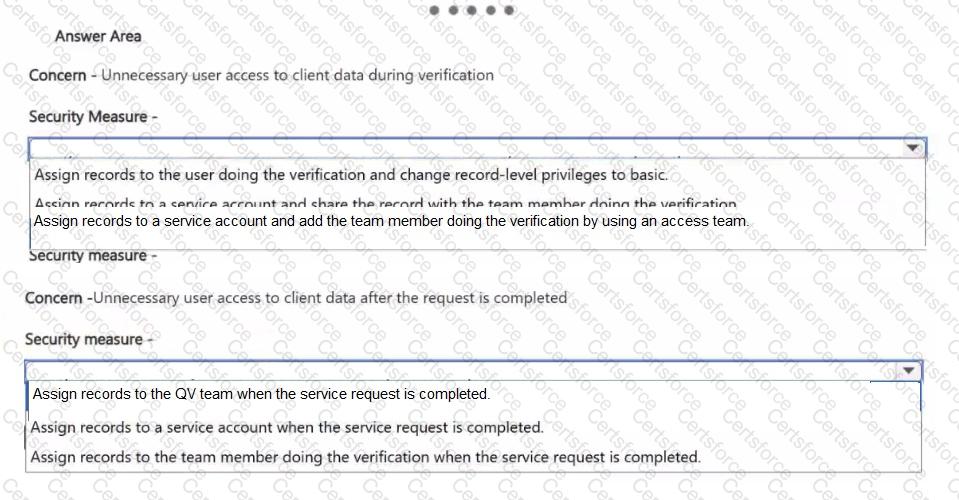
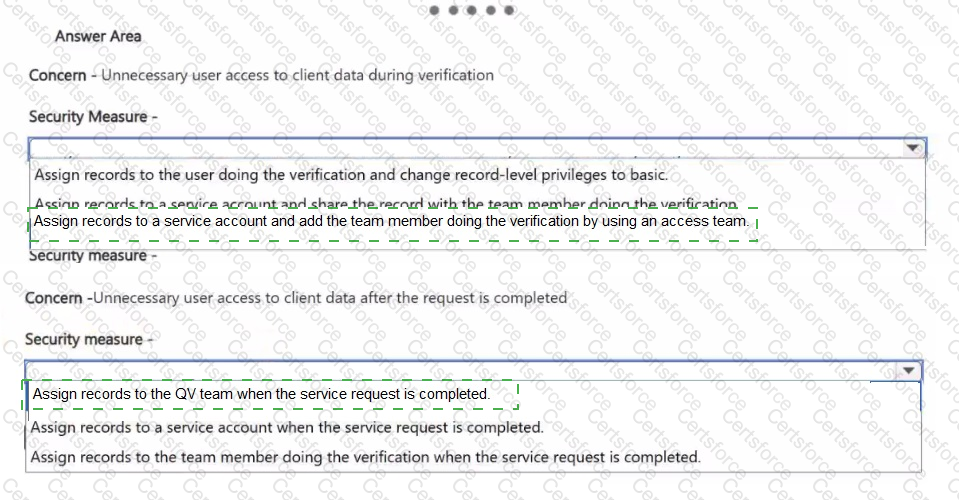
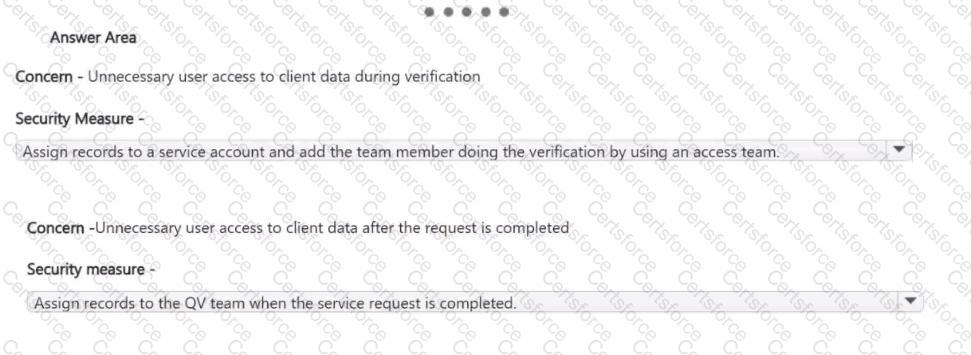
During verification: Assign records to a service account and add the current verifier by using an access team. After completion: Assign records to the QV team.
During active verification, an access team supports record-specific collaboration without granting every employee broad access to all client records. The Service Request can remain owned by a controlled service account, while only the team member performing that verification is added to the record ' s access team with the required rights. Access-team membership can be removed when the work ends. This is more precise than granting organization-wide privileges or assigning each record directly while allowing access to persist through broad roles. After the Service Request is completed, ownership should move to the QV owner team. An owner team can own rows and receives privileges from its assigned security roles, limiting continued access to the designated QV members who perform quality review. Assigning the completed record back to an individual verifier would preserve unnecessary personal access, while leaving it with a general service account would not itself establish the correct business-user access boundary. Microsoft distinguishes access teams, which receive rights to specific shared rows, from owner teams, which can own rows and hold security roles.
[Reference: https://learn.microsoft.com/en-us/power-apps/developer/data-platform/use-access-teams-owner-teams-collaborate-share-information, Study Guide alignment: Create a foundation for intelligent applications., ]
Contribute your Thoughts:
Chosen Answer:
This is a voting comment (?). You can switch to a simple comment. It is better to Upvote an existing comment if you don't have anything to add.


Submit