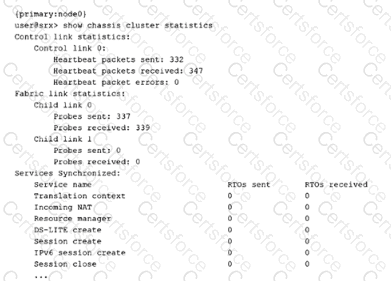
The correct answers are A and B. The exhibit shows show chassis cluster statistics. Under Control link statistics, Control link 0 has heartbeat packets sent and received, with heartbeat packet errors: 0. That is the clearest indication that the control link is operating normally. Juniper describes chassis-cluster control-plane verification as checking control-link heartbeat packets sent and received, along with heartbeat errors. If both send and receive counters are incrementing and errors are zero, the control link is functioning.
Option A is also correct because under Fabric link statistics, Child link 0 shows probes sent and probes received. Juniper uses fabric-link probe counters to verify fabric-link operation; nonzero sent and received probe counters indicate that the link is participating in fabric monitoring. Option C is not the safest conclusion from this exhibit alone. Child link 1 shows zero probes sent and received, but the output does not prove that a second fabric child link is configured and failing; it could simply be unused or not configured in this deployment. Option D is directly contradicted by the healthy heartbeat counters. Reference topics: HA Clustering, chassis cluster statistics, control-link heartbeat, fabric-link probes, cluster health verification.
Contribute your Thoughts:
Chosen Answer:
This is a voting comment (?). You can switch to a simple comment. It is better to Upvote an existing comment if you don't have anything to add.


Submit