Emerging Technology
Feature / Application Scenario
Edge computing
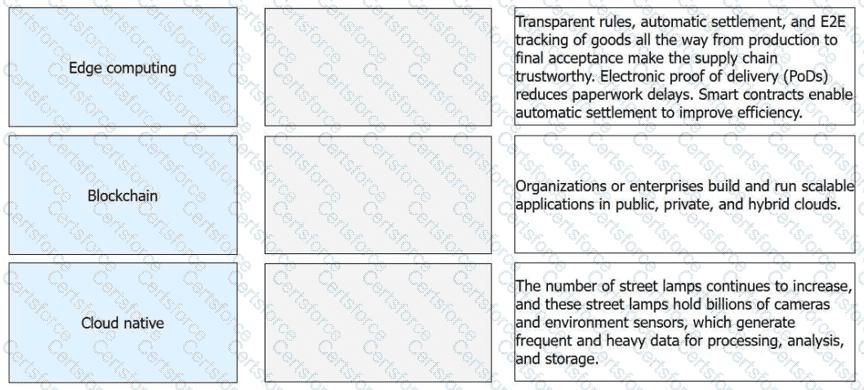
The number of street lamps continues to increase, and these street lamps hold billions of cameras and environment sensors, which generate frequent and heavy data for processing, analysis, and storage.
Blockchain
Transparent rules, automatic settlement, and E2E tracking of goods all the way from production to final acceptance make the supply chain trustworthy. Electronic proof of delivery (PoDs) reduces paperwork delays. Smart contracts enable automatic settlement to improve efficiency.
Cloud native
Organizations or enterprises build and run scalable applications in public, private, and hybrid clouds.
According to the Huawei HCIA-Cloud Computing curriculum, emerging technologies like Edge Computing, Blockchain, and Cloud Native are reshaping modern IT infrastructures to handle data more efficiently and securely. In the context ofEdge Computing, the massive proliferation of IoT devices in smart cities—such as billions of cameras and environmental sensors mounted on street lamps—creates a data influx that traditional centralized clouds cannot process in real time without significant latency. Edge computing solves this by moving processing and storage capabilities physically closer to the data sources, allowing for nearly instantaneous response times for critical urban systems like traffic management and public surveillance.
Blockchaintechnology provides a decentralized, distributed ledger that is transformative for global supply chain management. By creating a "single source of truth" that is transparent and immutable, it enables end-to-end (E2E) tracking of goods from production to the final consumer. A core feature is the use ofsmart contracts, which are automated, self-executing rules that trigger settlements and payments immediately upon meeting conditions like electronic proof of delivery (PoD), thereby eliminating intermediaries and reducing paperwork delays.
Finally,Cloud Nativerepresents an architectural approach designed to fully exploit the cloud computing model. The official definition from the Cloud Native Computing Foundation (CNCF) states that these technologies "empower organizations to build and run scalable applications in modern, dynamic environments such as public, private, and hybrid clouds". By utilizing independent microservices and portable containers, cloud-native applications achieve the high availability, elasticity, and rapid deployment speed required to meet evolving business needs across diverse infrastructure types.



Submit