Comprehensive and Detailed Explanation (200–250 words):
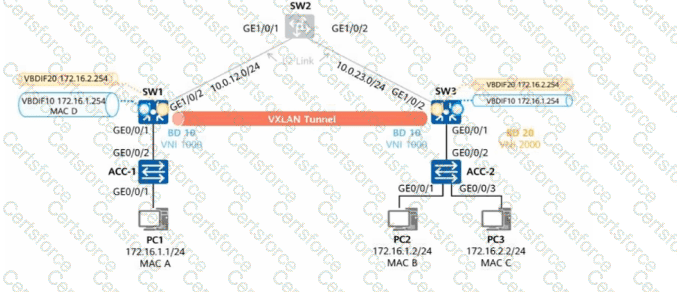
In this scenario,distributed VXLAN gatewaysare deployed, andlocal ARP proxyis enabled onVBDIF 10 of SW1. PC1 (172.16.1.1/24) needs to communicate with PC2 (172.16.1.2/24), which is located behind aremote distributed gateway (SW3).
Witharp-proxy local enable, SW1 doesnot flood ARP requests across the VXLAN tunnel. Instead, SW1 responds locally to PC1’s ARP request using theMAC address of its own VBDIF interface. Therefore, PC1 learns172.16.1.2 mapped to MAC D, which is the MAC address ofVBDIF 10 on SW1, not MAC B (the actual MAC of PC2). This makesstatement C trueandstatement A false.
Once PC1 sends traffic to PC2, the destination MAC in the frame isMAC D, meaning the packet is delivered to thelocal Layer 3 gateway. SW1 then performsLayer 3 routing, not Layer 2 switching. SW1 looks up theLayer 3 forwarding table, determines the remote VTEP, encapsulates the packet into VXLAN, and forwards it across the VXLAN tunnel. Therefore,statement D is true, whilestatement B is false.
This behavior aligns with HCIP Datacom Campus Network documentation fordistributed gateways with ARP proxy enabled, where traffic is routed locally and optimized across the VXLAN fabric.


Submit