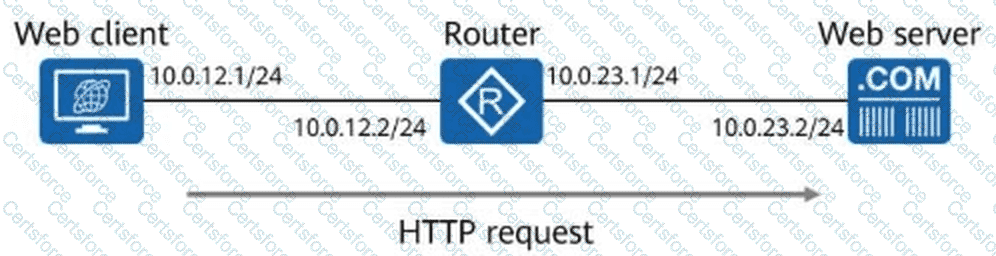
In the figure, a web client sends an HTTP request to a web server, and the router in between performs operations on the HTTP request. Which of the following statements are false about the router ' s operations? (Select all that apply)
A.
The router checks the content of the application-layer data and determines the port from which to send the data.
B.
The router removes the data frame header and checks the destination IP address.
C.
The router searches the IP routing table based on the port number in the transport-layer header.
D.
The router encapsulates a new destination IP address before sending the data.
Routers perform packet forwarding using network-layer information, particularly the destination IP address.
Option A is false because a conventional router does not need to inspect application-layer HTTP content to determine its outgoing interface. That decision is normally based on information in the routing table.
Option B is true. After receiving an Ethernet frame, the router removes its incoming data-link encapsulation and examines the destination IP address in the packet header.
Option C is false because destination TCP or UDP port numbers are not used for ordinary IP routing-table lookups.
Option D is false because normal forwarding does not replace the destination IP address. The router changes the Layer 2 encapsulation for the next hop while retaining the original IP destination unless another feature, such as NAT, performs address translation.
Therefore, A, C, and D are false statements.
================
Contribute your Thoughts:
Chosen Answer:
This is a voting comment (?). You can switch to a simple comment. It is better to Upvote an existing comment if you don't have anything to add.


Submit