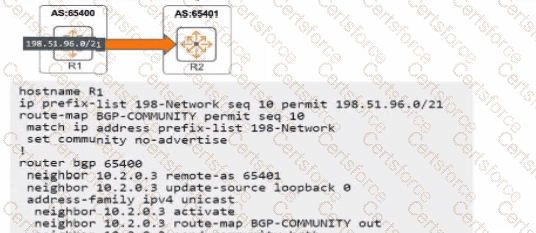
The question asks for the effects of adding the command neighbor 10.2.0.3 send-community both to the BGP configuration under the IPv4 address family context for neighbor R2 (10.2.0.3) on router R1.
send-community both:This command instructs R1 to send both standard (RFC 1997) and extended (RFC 4360) BGP community attributes to neighbor R2. By default, communities are not sent.
BGP Capability Negotiation:Adding or changing features like community advertisement modifies the BGP capabilities exchanged between neighbors during session establishment. Any change to these capabilities requires the BGP session to be reset (flap) so that the peers can renegotiate using the new capabilities.
Analysis of Options (Select Two):
A: Correct (partially). It enables R1 tosendstandard and extended communities. The ability toreceivedepends on the peer and local config. The capability isnegotiatedupon session reset.
B: Incorrect. Changing capabilities requires the session to flap; it's not without consequence.
C: Incorrect. It primarily enablesoutboundsending from R1. Inbound acceptance is implicit if the neighbor is activated.
D: Correct. Modifying BGP neighbor capabilities, such as enabling send-community, necessitates a BGP session reset (flap) for the change to take effect.
Conclusion:The command enables R1 to send communities (A describes the purpose/capability), and adding this command to an existing session will cause the session to flap for renegotiation (D describes the immediate consequence).
[References:RFC 1997, RFC 4360, AOS-CX BGP Configuration Guide (communities, neighbor configuration). This relates to the "Routing" (16%) objective., ]
Contribute your Thoughts:
Chosen Answer:
This is a voting comment (?). You can switch to a simple comment. It is better to Upvote an existing comment if you don't have anything to add.


Submit