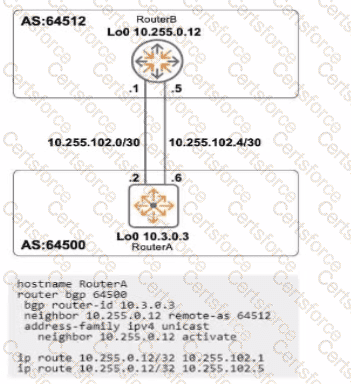
Review the diagram and existing configuration of RouterA above. Which configuration changes are necessary to permit load balancing between RouterA and RouterB? (Selecttwo)
RouterA (AS 64500) peers with RouterB (AS 64512) using eBGP.
Peering is configured between loopback interfaces (RouterA Lo0 10.3.0.3 to RouterB Lo0 10.255.0.12).
Two parallel physical links connect the routers (10.255.102.0/30 and 10.255.102.4/30).
RouterA has two static routes pointing to RouterB's loopback (10.255.0.12/32), one via each physical link's next hop (10.255.102.1 and 10.255.102.5). This provides reachability to the BGP peer address over both paths.
RouterA's BGP config activates the neighbor 10.255.0.12 for IPv4 unicast but is missing key commands for stable loopback peering and load balancing.
Goal:Permit load balancing for traffic exchanged via BGP between RouterA and RouterB. This requires BGP ECMP (Equal Cost Multi-Path).
Requirements for eBGP ECMP over Loopbacks:
Stable Peering:Peering must use loopback addresses. This requires:
update-source loopback : To source BGP TCP packets from the loopback IP.
ebgp-multihop : Because loopbacks are not directly connected (TTL > 1 needed).
ECMP Enabled:BGP must be configured to allow multiple paths in the routing table. This requires:
maximum-paths (or maximum-paths ebgp ): To allow more than the default 1 path.
Equal Paths:BGP must see multiple paths to thesameprefix learnedfrom RouterBthat are considered equal based on BGP path selection attributes (Weight, Local_Pref, AS_Path, Origin, MED, etc.). Since routes are learned from the same neighbor IP (RouterB's loopback), these attributes will likely be identical for routes learned via this peering. RouterA already has equal static routestothe BGP next hop (10.255.0.12).
Contribute your Thoughts:
Chosen Answer:
This is a voting comment (?). You can switch to a simple comment. It is better to Upvote an existing comment if you don't have anything to add.







Submit