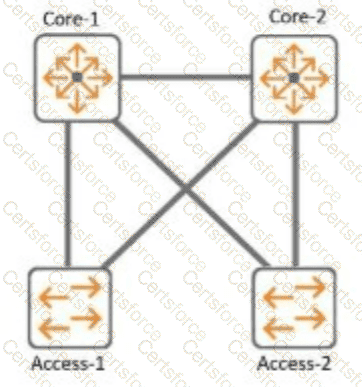
In MSTP, root-bridge priority is configured per MST instance , not directly per individual VLAN. Since Core-1 already has spanning-tree instance 1 priority 0, Core-1 is intended to become the preferred root for MST instance 1 . To make VLAN 10 use that spanning-tree topology, VLAN 10 must therefore be mapped into instance 1 with:
spanning-tree instance 1 vlan 10
HPE Aruba Networking documents this exact syntax and states that the command either creates an MST instance with the specified VLAN mapping or maps a VLAN to an existing instance. Aruba Networks
This is how MSTP provides VLAN load balancing. Different VLANs can be assigned to separate MST instances, and each instance can have a different root bridge. For example, VLAN 10 can belong to instance 1 with Core-1 as root, while VLAN 20 can belong to another instance whose root priority favors Core-2 . Aruba specifically describes this ability to forward different VLAN groups along separate paths as an MSTP load-sharing mechanism. Aruba Networks
Options B, C, and D are not the appropriate AOS-CX MSTP VLAN-to-instance mapping syntax. The required command is therefore A .
Study Guide Topics: MSTP, MST Instances, VLAN-to-Instance Mapping, Root Bridge Priority, VLAN Load Balancing, AOS-CX Spanning Tree.


Submit