Exhibit item
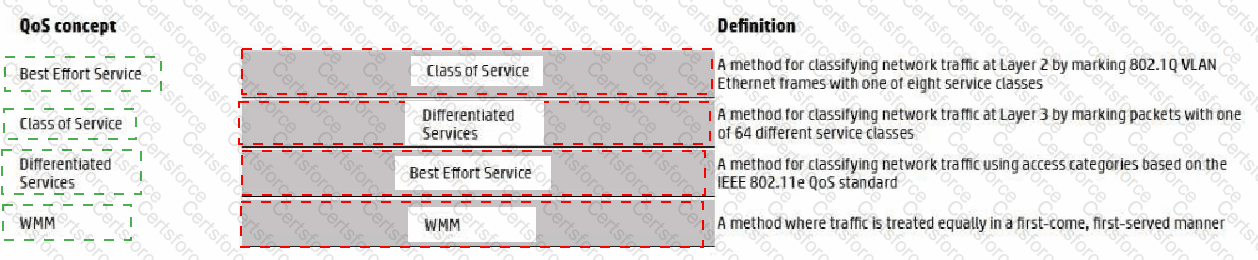
Correct match
Class of service
Layer 2 classification marking
Differentiated Services Code Point
Layer 3 IP QoS marking
Strict Priority
Always serves selected queue before lower priorities
DWRR
Weighted scheduling distributes bandwidth among queues
Comprehensive and Detailed Explanation
HPE Press guide context | PDF page 189 | HPE Press, Aruba Certified Associate – Campus Access Official Certification Study Guide
Technical Deep Dive — Reconstructed (Original Chat Text Not Recoverable)
QoS classification and marking distinguish classes of traffic, scheduling determines queue service order, and shaping/rate limiting control offered rates. DSCP is a Layer 3 six-bit marking; CoS/802.1p is Layer 2. Strict priority favors selected queues; DWRR allocates weighted service across eligible queues.
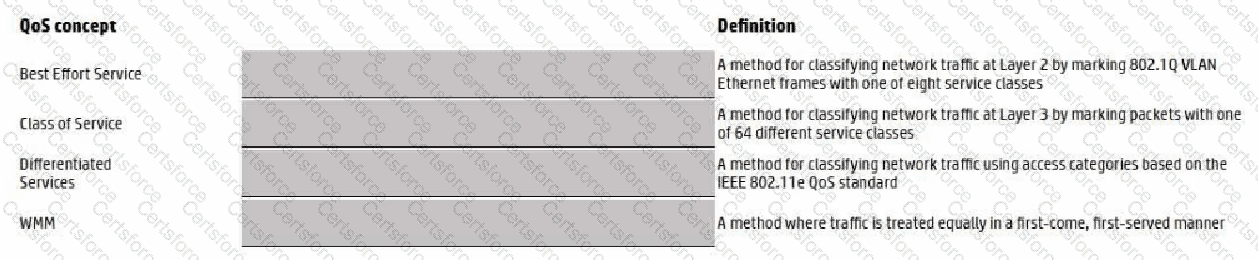
The exhibit is a matching question: each original item must be paired with the applicable protocol, medium, security function, or address classification. The answer table below records the intended correspondence without changing the source exhibit.
Operational workflows should preserve consistent inventory, authorization, configuration history, and monitoring so that administrators can locate and manage devices predictably.
For example, a cloud-managed infrastructure device may be registered successfully but still require the correct subscription, site, group, and configuration scope.
In production, the decision should be documented and checked against the supported software release and platform model, because interface names, licensing tiers, and management workflows can change across Central and AOS-CX generations.
For practical use, confirm the prerequisite conditions first, then verify the resulting operational state. This separates an intended configuration from a working network service and avoids accepting a misleading result.


Submit