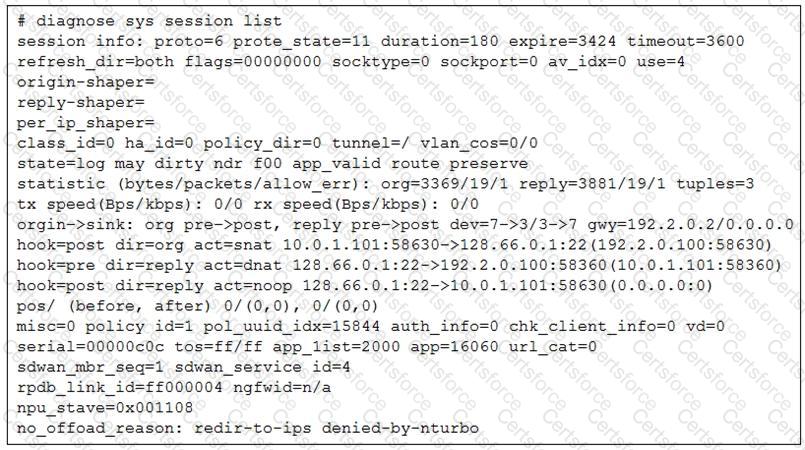
Refer to the exhibit. The administrator configured the SD-WAN rule ID 4 with two members (port1 and port2) and strategy lowest cost (SLA). What are the two characteristics of the session shown in the exhibit? (Choose two.)
Exhibit 1
A.
FortiGate steered this flow according to an SD-WAN rule 4.
B.
FortiGate will never re-evaluate this session.
C.
FortiGate steered this flow according to the application detected and the outgoing interface is port3.
D.
FortiGate will re-evaluate this session if the outgoing interface goes down.
The line sdwan_mbr_seq=1 sdwan_service_id=4 indicates that this session is part of an SD-WAN rule. sdwan_service_id=4 confirms that the session is being handled by SD-WAN rule ID 4. This directly links the flow to the SD-WAN configuration. The line no_offload_reason: redir-to-ips denied-by-nturbo shows that the session is not offloaded to the NPU (Network Processing Unit) and is being processed by the main CPU. A session that is not offloaded can be re-evaluated. If the outgoing interface (the one currently being used) goes down, the FortiGate will re-evaluate the session against the SD-WAN rules to find a new active member to steer the traffic through. This is a fundamental behavior of SD-WAN, which ensures network resilience. An operational review should distinguish the rule that matches the traffic from the interface that is ultimately selected. Valid forwarding also depends on destination route eligibility, current member state and the applicable SLA or quality-selection algorithm. A diagnostic showing configured members alone is not conclusive evidence that all those members will carry a particular flow.
Chosen Answer:
This is a voting comment (?). You can switch to a simple comment. It is better to Upvote an existing comment if you don't have anything to add.


Submit