FortiGate SD-WAN evaluates traffic against configured service rules and uses eligible member interfaces to determine the forwarding path. In this scenario, the destination is an internal corporate server accessible through the SD-WAN overlay.
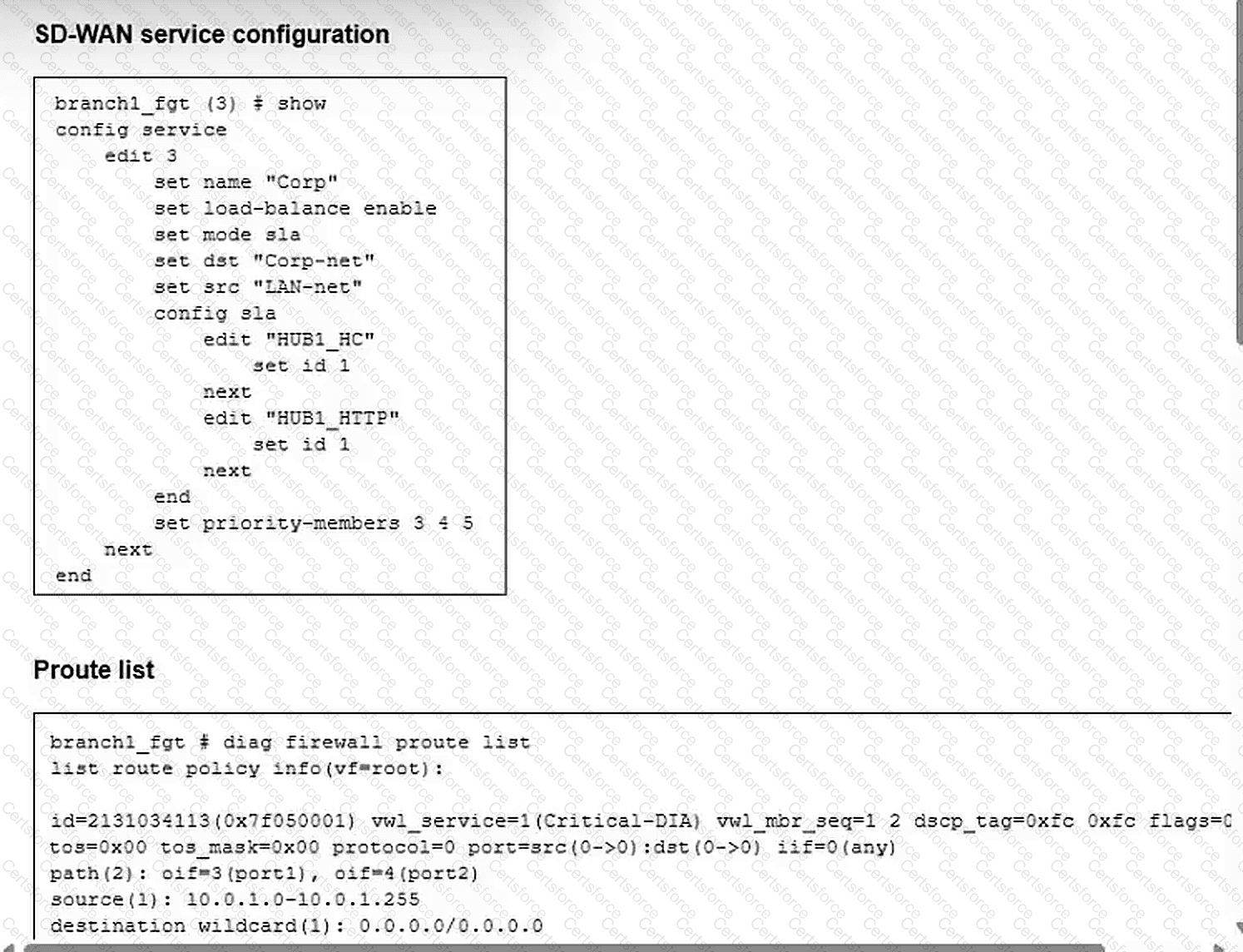
The exhibit identifies SD-WAN service rule 3, named Corp , with the following configuration:
set load-balance enable
set mode sla
set dst " Corp-net "
set src " LAN-net "
set priority-members 3 4 5
Option D is correct because the rule enables SLA-based load balancing across three overlay members corresponding to HUB1-VPN1, HUB1-VPN2, and HUB1-VPN3.
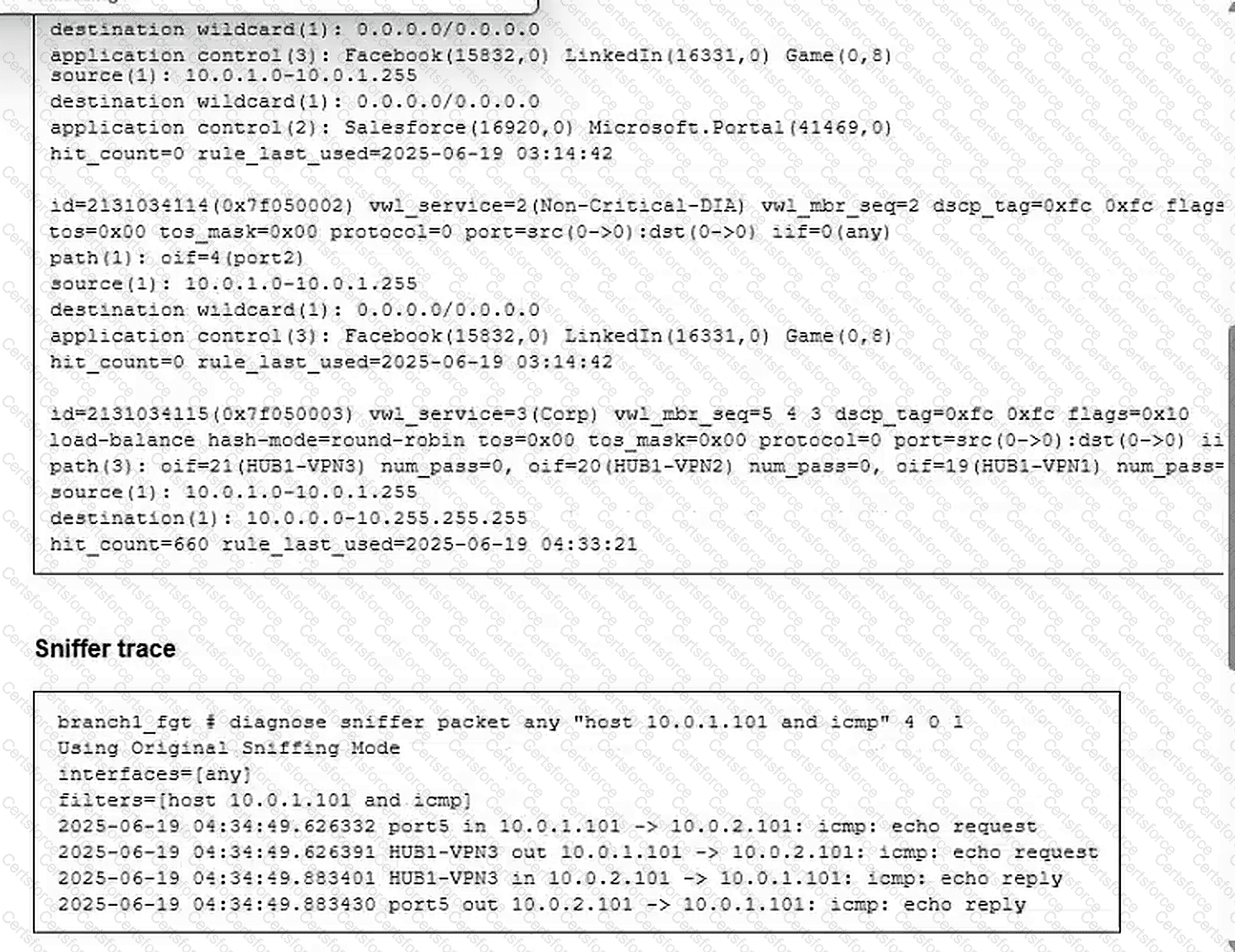
The route-list output confirms that the corporate service rule has three available paths. Provided the members remain healthy, meet the applicable SLA requirements, and have valid destination reachability, FortiGate can distribute qualifying sessions among these interfaces.
Option B incorrectly assumes that the interface observed in the packet-sniffer output must carry every subsequent session. The displayed ICMP traffic uses HUB1-VPN3, but this observation does not establish exclusive forwarding for HTTP sessions.
Options A and C identify physical WAN interfaces rather than the eligible corporate VPN overlay members.
FortiGate applies the configured load-balancing algorithm when selecting an eligible member for a new session. The original question establishes that all SD-WAN links are stable, supporting the use of the available overlay paths.
[References: FortiOS 7.6 Administration Guide — SD-WAN Rules, Lowest Cost (SLA), Load Balancing, and SD-WAN Routing Logic., ==========, ]


Submit