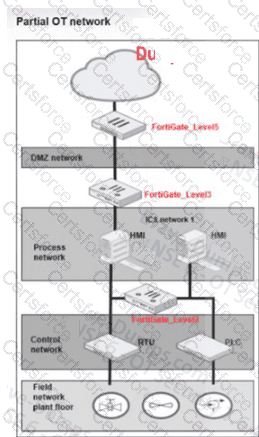
For the installation of your first FortiGate device, you want to minimize the impact in your OT network. Therefore, you deploy it initially as an offline IDS. Which two statements about this deployment are correct? (Choose two answers)
A.
The FortiGate device acts as a network sensor.
B.
The cybersecurity visibility increases with the security profiles.
Deploying a FortiGate in offline IDS (also known as one-arm sniffer mode) is a common strategy in OT environments for several reasons found in the study guide:
Priority of Availability : In OT, availability and safety are critically important and prioritized higher than in IT. An offline IDS minimizes impact because it does not sit in the direct path of production traffic.
Network Sensor Role : In this mode, the FortiGate is connected to a mirror/SPAN port on a switch. It acts as a network sensor , receiving a copy of the traffic rather than having the traffic flow through it. This confirms Statement A is correct and Statement D is incorrect.
Passive vs. Active : The guide explicitly states that in OT environments, passive methods are preferred over active methods to avoid negatively impacting performance or causing process interruptions.
Depth of Visibility : Even though the device is offline, you apply security profiles (such as IPS, Application Control, and Antivirus) to the sniffer interface. This allows the FortiGate to analyze the copied traffic and provide deep visibility into the OT assets and their behaviors. This confirms Statement B is correct.
Detection vs. Prevention : An IDS (Intrusion Detection System) is passive ; it can detect threats but cannot reset connections or drop packets to block attacks. Therefore, it cannot block zero-day attacks, making Statement C incorrect.
Contribute your Thoughts:
Chosen Answer:
This is a voting comment (?). You can switch to a simple comment. It is better to Upvote an existing comment if you don't have anything to add.
Submit