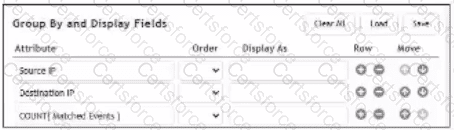
The correct answer is B because the configuration groups results by Source IP and Destination IP , while using COUNT(Matched Events) as a display/aggregate value. FortiSIEM’s grouping logic combines events only when the selected Group By attributes match. The Study Guide explains that Group By attributes determine how matching events are placed into rows, and that when multiple events share the same grouped values, “they are grouped together in one row.” The count column then tracks the number of events represented by that row. In the exhibit, Source IP and Destination IP are the grouping fields, so FortiSIEM displays each unique connection pair once. The count shows how many matching allowed firewall connection events were seen for each pair. Option A is not correct because the exhibit does not show sorting by destination IP hit count. Option C ignores the source and destination grouping. Option D would require grouping by source IP alone or by distinct destination counts per source, which is not the shown configuration.
Contribute your Thoughts:
Chosen Answer:
This is a voting comment (?). You can switch to a simple comment. It is better to Upvote an existing comment if you don't have anything to add.


Submit