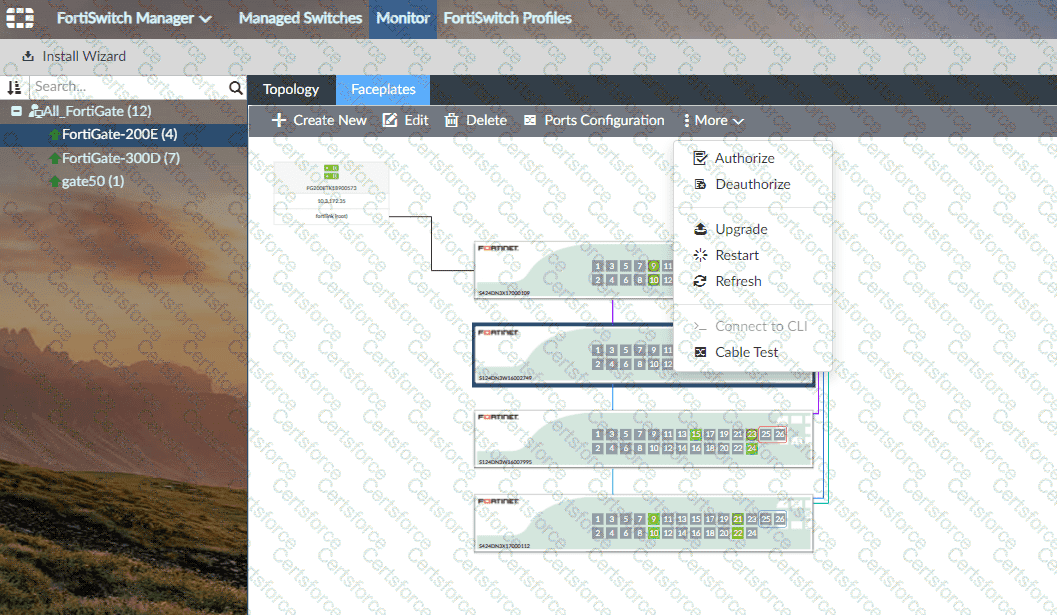
In a FortiLink-managed switching architecture, the FortiGate firewall acts as the centralized controller for downstream FortiSwitch devices. TheFortiSwitch Faceplatesview in the FortiGate GUI provides a physical-style representation of switch ports, including port numbers, operational status, link state, speed, duplex, and connected neighbor information. According to FortiOS 7.6 and FortiSwitchOS 7.6 documentation fromFortinet, this port-level intelligence is derived fromLink Layer Discovery Protocol (LLDP)advertisements received from the FortiSwitch.
LLDP is an IEEE 802.1AB standard protocol used for vendor-neutral Layer 2 neighbor discovery. FortiSwitch periodically sends LLDP frames that include detailed port descriptors such as chassis ID, port ID, port description, system name, system capabilities, and VLAN-related attributes. When FortiGate receives these LLDP advertisements over the FortiLink interface, it correlates the information with the managed FortiSwitch inventory and renders accurate port details in the Faceplates view.
Other options are incorrect for the following reasons. The FortiSwitch model alone is insufficient to populate per-port operational details. Cisco Discovery Protocol (CDP) is a Cisco-proprietary protocol and is not used by FortiGate for Faceplates visualization. FortiLink discovery frames are used to establish and maintain the FortiLink management relationship, but they do not carry the granular per-port metadata required for the Faceplates display.
Therefore, the Faceplates view relies specifically onLLDP advertisements received from the FortiSwitch, making optionCthe correct and fully verified answer based on FortiOS 7.6 and FortiSwitchOS 7.6 behavior.



Submit