The issue is caused by the strict matching logic of the configured Prefix List.
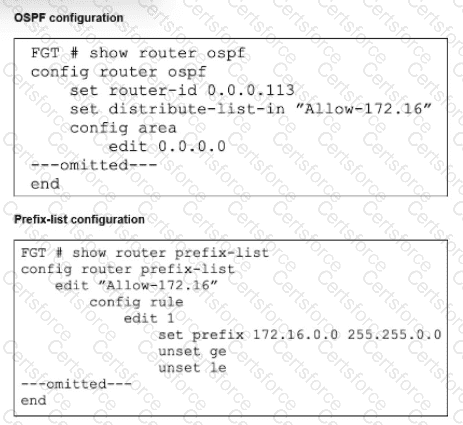
Current State: The rule is edit 1 with set prefix 172.16.0.0 255.255.0.0 and both ge (greater than or equal) and le (less than or equal) are unset.
Behavior: When ge and le are unset, FortiOS requires an exact match of the subnet mask. The current rule only matches the exact network 172.16.0.0/16. It denies 172.16.52.0/24 because the mask (/24) does not match the rule ' s mask (/16).
To fix this and inject 172.16.52.0/24, you must modify the list to match the /24 mask:
A. Add another entry to the prefix list to specifically allow the 172.16.52.0/24 network:
Creating a new rule (e.g., edit 2) with set prefix 172.16.52.0 255.255.255.0 will provide an exact match for the incoming route, allowing it to pass the distribute-list.
B. Change the ge value to 17:
By configuring set ge 17 on the existing rule (conceptually 172.16.0.0/16 ge 17), you change the logic from " exact match " to " range match " .
This configuration tells the router to match any prefix starting with 172.16.x.x that has a subnet mask length of 17 or greater.
Since the incoming route is a /24, and 24 is greater than 17, the route will match the prefix list and be accepted.
Why other options are incorrect:
C: The option text appears to read " Change the ... value to 16 " . If this refers to le 16, it would enforce the mask to be exactly /16 or less, which still excludes /24.
D: Changing the default behavior to implicit allow defeats the purpose of a filter (security control) and is not a standard configuration step for fixing a single missing route.
[Reference:, FortiGate Security 7.6 Study Guide (Routing): "In prefix-lists, if ge and le are not used, the subnet mask must match exactly. To match subnets within a range, you must define the prefix length boundaries using ge or le.", , , ]


Submit