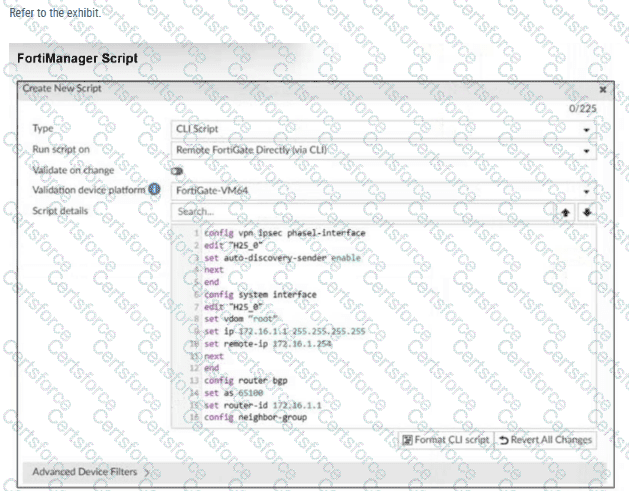
The correct answers are B and C . The FortiManager 7.6 Administrator Study Guide explicitly states: “Scripts that you run directly on remote devices also cause automatic updates and create a revision history.” This exact extract proves both results: FortiManager creates a new revision history and the device status becomes Auto-Updated , meaning the FortiGate change is automatically reflected in the FortiManager device-level database.
The lab guide also distinguishes this from database-targeted scripts by stating: “You must perform an installation if you run a script on a device database, policy package, or ADOM database.” That wording excludes Remote FortiGate Directly via CLI , so D is incorrect.
A is also incorrect because direct remote execution does not use the install preview workflow; preview and validation are tied to Install Wizard operations, not direct CLI execution.
=========
Contribute your Thoughts:
Chosen Answer:
This is a voting comment (?). You can switch to a simple comment. It is better to Upvote an existing comment if you don't have anything to add.


Submit