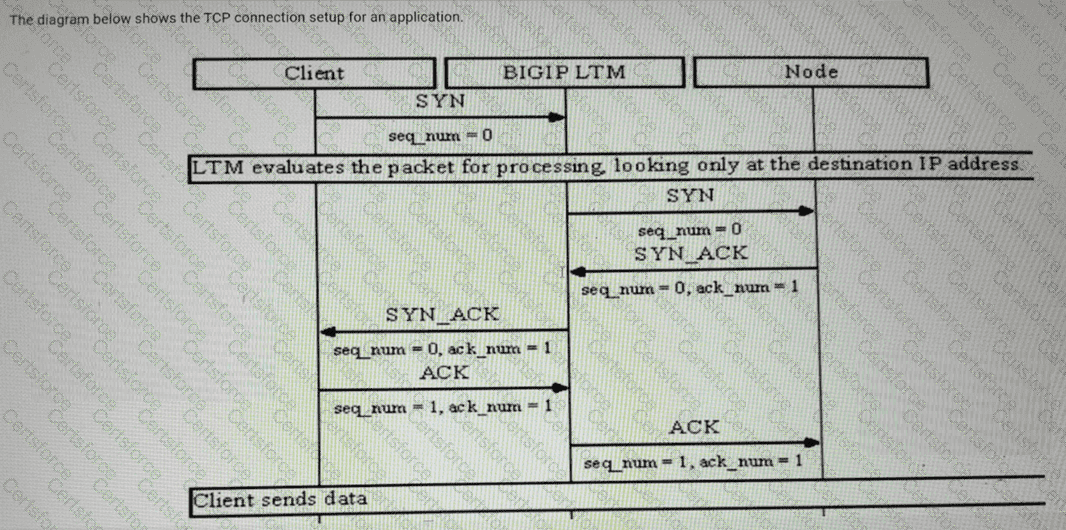
The diagram illustrates a specific TCP handshake sequence where the BIG-IP system acts as a transparent forwarder rather than a full proxy. The key indicators that identify this as aForwarding (IP) virtual serverare as follows:
Initial Packet Processing: The diagram explicitly states that the LTM evaluates the packet lookingonly at the destination IP address. This is the fundamental characteristic of a Forwarding IP virtual server, which uses the system's routing table to make forwarding decisions instead of load balancing to a pool of members.
Handshake Sequence: Unlike aStandardvirtual server, which completes the three-way handshake with the client (SYN, SYN-ACK, ACK)beforeinitiating a separate connection to the server, the Forwarding IP virtual server passes the client's originalSYNpacket directly to the destination node.
Response Timing: The BIG-IP system waits for theSYN-ACKfrom the destination node before it sends a SYN-ACK back to the client. It essentially "passes through" the handshake signals while still maintaining a state entry in the connection table to track the flow.
Packet-by-Packet Logic: While it tracks the state, it does not perform address translation (unless SNAT is specifically configured) or deep packet inspection like a full proxy would.
Why other options are incorrect:
Standard virtual server: A Standard virtual server is a "full proxy." It would finish the handshake with the client first and only then open a second, independent TCP connection to the backend server.
Stateless virtual server: A stateless virtual server does not track connections in the connection table. The diagram shows the system meticulously passing sequence numbers ($seq\_num$) and acknowledgment numbers ($ack\_num$) between the two sides, which requires stateful tracking of the TCP flow.
Contribute your Thoughts:
Chosen Answer:
This is a voting comment (?). You can switch to a simple comment. It is better to Upvote an existing comment if you don't have anything to add.


Submit