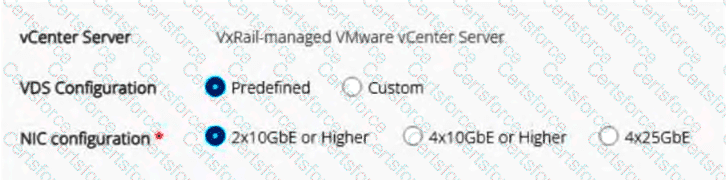
In a VxRail deployment where the "Predefined" virtual distributed switch (VDS) configuration is selected alongside a "2x10GbE or Higher" dual-NIC layout, the automated installer applies deterministic network load-balancing and failover policies. Because a 2-NIC profile aggregates all foundational infrastructure traffic—including Management, vMotion, vSAN, and Virtual Machine networks—onto a single pair of physical uplinks (Uplink 1 and Uplink 2), logical segregation is critical to prevent contention and ensure data path reliability.
To achieve this, the predefined architecture utilizes an explicit failover ordering mechanism rather than a standard active/active load-balancing state across the uplinks. For the vSAN port group, which carries high-throughput storage synchronization traffic, the network design configures Uplink 1 as Standby and Uplink 2 as Active. This configuration maps directly to a Standby/Active setup. Conversely, the Management port group operates in an inverse fashion, utilizing Uplink 1 as Active and Uplink 2 as Standby. This layout optimizes bandwidth usage across both physical connections during standard operations, while guaranteeing that full path redundancy remains maintained if an upstream switch link failover event occurs.
[References: Dell VxRail Deploy Study Guide; Predefined VDS Network Topologies; Teaming and Failover Policies., , ]


Submit