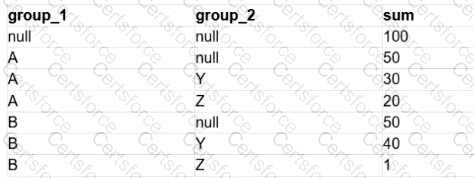
Option D is correct because the table has zero real null values, but the result contains null values representing subtotal and grand-total rows. That behavior is produced by WITH CUBE, which creates aggregations for combinations of grouping columns, including (group_1, group_2), (group_1), (group_2), and the grand total (). The Databricks SQL documentation states that GROUP BY supports advanced aggregations through CUBE, and that CUBE is shorthand for grouping sets. Option A only returns detailed groups. Options B and C use invalid syntax in Databricks SQL. Reference: Databricks GROUP BY clause documentation.
Contribute your Thoughts:
Chosen Answer:
This is a voting comment (?). You can switch to a simple comment. It is better to Upvote an existing comment if you don't have anything to add.






Submit