The correct answer is C. standby supervisor.
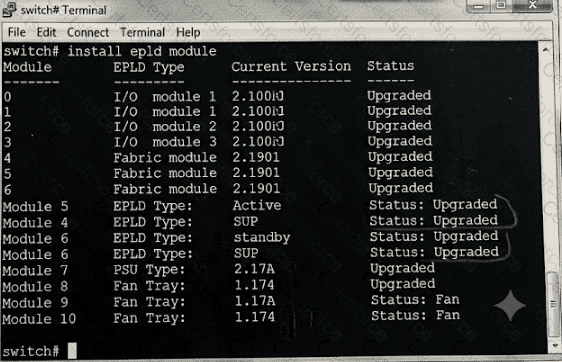
From the exhibit, the command output clearly shows:
Module 6 SUP Yes disruptive Module Upgradable and later confirms:
Module 6 EPLD upgrade is successful and 6 SUP Success.
This indicates that the EPLD upgrade was performed on a Supervisor (SUP) module, specifically module 6. In Cisco MDS 9700 architecture, supervisor modules operate in a redundant pair (active and standby). When EPLD upgrades are performed, Cisco best practice and system behavior typically upgrade the standby supervisor first, because it allows the system to maintain control-plane continuity and minimizes disruption.
The output does not mention PSU, fan, or fabric modules, eliminating options A, B, and D. The explicit reference to SUP confirms that the upgrade applies to a supervisor module.
Thus, based on the module type shown in the output and standard Cisco upgrade behavior, the EPLD upgrade is applied to the standby supervisor, making C the correct answer.


Submit