In a BGP EVPN VXLAN multi-homing design, Ethernet Segment Identifiers (ESIs) are used to represent a set of links from one or more leaf switches to the same downstream device (such as a CE, firewall, or aggregation switch). By default, when multiple leafs share the same ESI, the EVPN design supportsall-activeredundancy, where all participating leafs can forward traffic for that Ethernet segment simultaneously.
However, some use cases—like connecting to devices that do not support multipath forwarding or for strict active/standby redundancy—requiresingle-activemulti-homing. In single-active mode, only one leaf in the Ethernet segment forwards traffic at any time; the other leaf(s) act as standby and only take over if the active node fails. This behavior is explicitly controlled in the EVPN Ethernet-segment configuration.
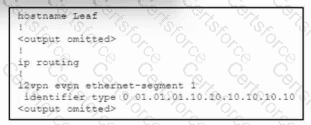
On Cisco platforms for EVPN VXLAN fabrics, this is configured under thel2vpn evpn ethernet-segmentstanza using the command:
l2vpn evpn ethernet-segment 1
identifier type 0 01.01.01.10.10.10.10.10.10.10
redundancy single-active
identifier type 0 ... defines the ESI for the multi-homed connection.
redundancy single-active specifies that only one leaf in that ESI is allowed to be active at a time, thus enablingdual-homing with single-active redundancy.
The other options do not relate to Ethernet-segment redundancy mode:
B. default-gateway advertiseis used in EVPN anycast gateway configurations to advertise the default gateway MAC/IP, not for ESI redundancy.
C. replication-type staticis associated with multicast or ingress replication behavior for VXLAN VTEPs, not Ethernet-segment redundancy.
D. vlan configuration 101is a VLAN configuration context command and has no effect on EVPN ESI redundancy.


Submit