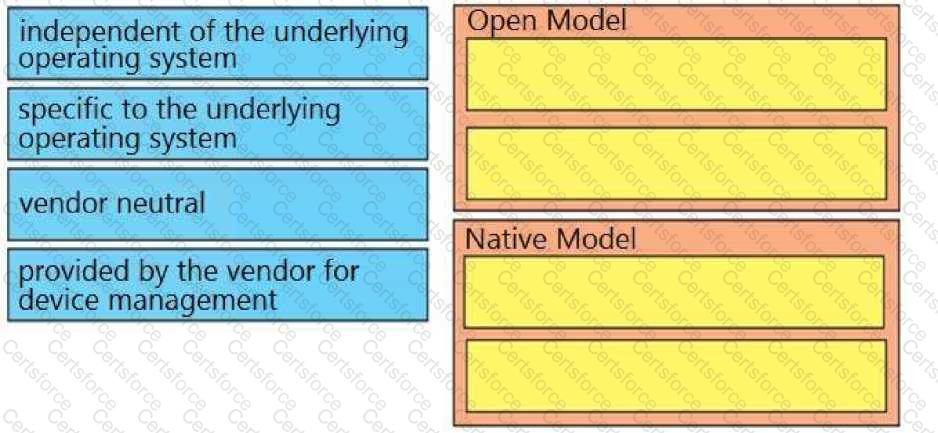
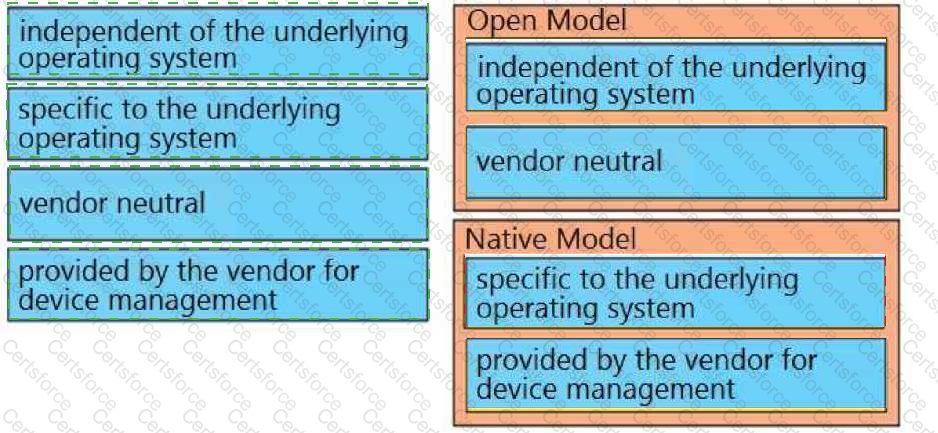
The drag-and-drop mapping is based on how Cisco differentiates YANG model families used for model-driven programmability. IETF models are standards-based and are intended for broad interoperability across vendors. They are the usual choice when the design priority is a consistent baseline for multivendor configuration or operational state. OpenConfig models are also vendor-neutral, but they are developed by the OpenConfig community and often provide an operationally consistent structure for telemetry and configuration across platforms. Cisco native models are vendor-specific models that expose detailed Cisco IOS XE, IOS XR, or NX-OS features, including capabilities that may not be represented in IETF or OpenConfig models. The design choice is therefore not simply “one model is always best.” It depends on whether the requirement prioritizes portability, abstraction, or complete Cisco feature coverage. For a standards-driven multivendor design, use IETF or OpenConfig where sufficient. For Cisco-specific device features, use Cisco native models. Reference topics: YANG models, IETF models, OpenConfig, Cisco native models, NETCONF/RESTCONF programmability.
Contribute your Thoughts:
Chosen Answer:
This is a voting comment (?). You can switch to a simple comment. It is better to Upvote an existing comment if you don't have anything to add.


Submit