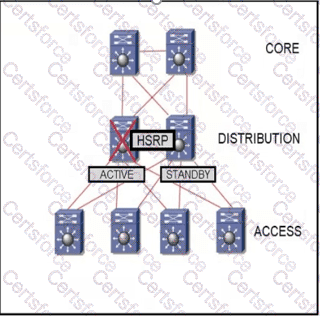
Refer to the exhibit. The distribution switches serve as the layer 3 boundary. HSRP preemption is enabled. When the primary switch comes back after a failure, traffic is initially dropped. Which solution must be implemented to improve the design?
A.
Increase the hello timers on both HSRP devices
B.
Use the preempt delay feature on the primary HSRP device.
C.
Use the preempt delay feature on the backup HSRP device
D.
Configure a higher mac-refresh interval on both HSRP devices
The primary HSRP device should use the preempt delay feature. When a failed primary distribution switch returns, HSRP preemption allows it to reclaim the active gateway role because it has the higher priority. However, routing protocols, trunks, line cards, FIB programming, or upstream convergence may not be fully ready at the instant HSRP becomes active again. If the device preempts too quickly, hosts forward traffic to a gateway that is not yet ready to forward all flows, causing temporary packet loss. Cisco HSRP preempt delay prevents immediate takeover by delaying preemption after reload or interface recovery, giving the switch time to rebuild control-plane and forwarding-plane state. Increasing hello timers slows failure detection and does not solve the premature takeover problem. Applying preempt delay to the backup device is not the issue because the returning primary is the device that reclaims active state. MAC refresh timers are not the primary mechanism for this condition. Therefore, the design should configure preempt delay on the primary HSRP device. Reference topics: HSRP preemption, preempt delay, gateway recovery, campus high availability, convergence coordination.
Contribute your Thoughts:
Chosen Answer:
This is a voting comment (?). You can switch to a simple comment. It is better to Upvote an existing comment if you don't have anything to add.


Submit