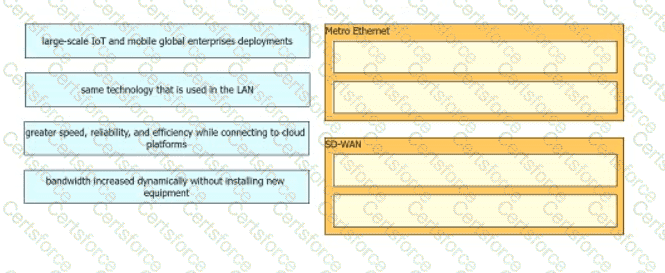
The drag-and-drop mapping should be preserved as the validated answer because the item depends on the exhibit categories and the original coordinate map identifies which descriptions belong to each category. In Cisco design questions of this form, the important skill is distinguishing the functional category from the implementation detail. A professional design answer must map each description to the correct operational class instead of treating all items as interchangeable features. This is common in ENSLD topics such as WAN connectivity, SD-Access roles, telemetry modes, and QoS service models, where a description may sound similar but belongs to a different architectural layer. The coordinate answer keeps the specific pairings intact while the explanation documents the design logic: categorize by function, control-plane responsibility, data-plane behavior, and operational use case. If the exhibit contains technology categories, the selected mapping should be read as the official answer for those categories rather than converted into free text. Reference topics: Cisco design categorization, architectural roles, technology-to-function mapping, ENSLD drag-and-drop interpretation.
Contribute your Thoughts:
Chosen Answer:
This is a voting comment (?). You can switch to a simple comment. It is better to Upvote an existing comment if you don't have anything to add.



Submit