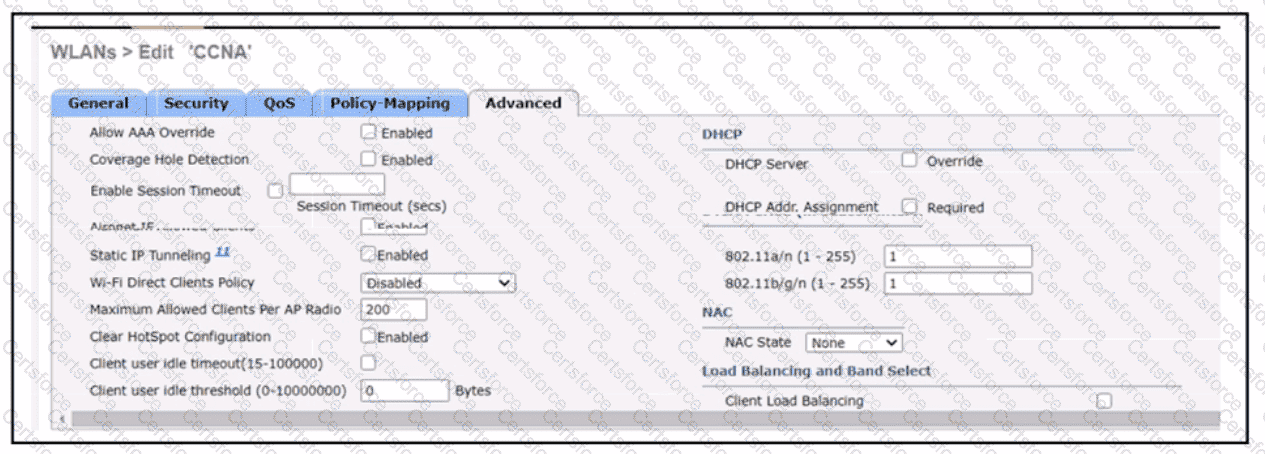
A network engineer configures the CCNA WLAN so that clients must authenticate hourly and to limit the number of simultaneous connections to the WLAN to Which two actions complete this configuration? (Choose two.)
A.
Enable the Enable Session Timeout option and set the value to 3600.
B.
Set the Maximum Allowed Clients value to 10.
C.
Enable the Client Exclusion option and set the value to 3600.
D.
Enable the Wi-Fi Direct Clients Policy option.
E.
Set the Maximum Allowed Clients Per AP Radio value to 10.
Answer A,B is correct: A. Enable the Enable Session Timeout option and set the value to 3600.; B. Set the Maximum Allowed Clients value to 10.. Cisco wireless design separates RF behavior, client authentication, encryption, AP operating mode, and controller management. A WLC centralizes WLAN configuration and AP control, while lightweight APs use CAPWAP to register and exchange control/data information with the controller. Security choices such as WPA2/AES and WPA3/SAE are not interchangeable with older mechanisms such as WEP, TKIP, or RC4. RF questions also depend on channel planning: adjacent cells should avoid overlapping channels, and 5-GHz preference features reduce congestion in the 2.4-GHz band. The incorrect options generally confuse AP mode, authentication, encryption, or controller responsibilities. Cisco CCNA 200-301 v1.1 includes these items because wireless failures often come from using the right-looking feature in the wrong part of the WLAN design. The selected answer is the Cisco-consistent configuration or behavior for this wireless scenario.
Contribute your Thoughts:
Chosen Answer:
This is a voting comment (?). You can switch to a simple comment. It is better to Upvote an existing comment if you don't have anything to add.


Submit