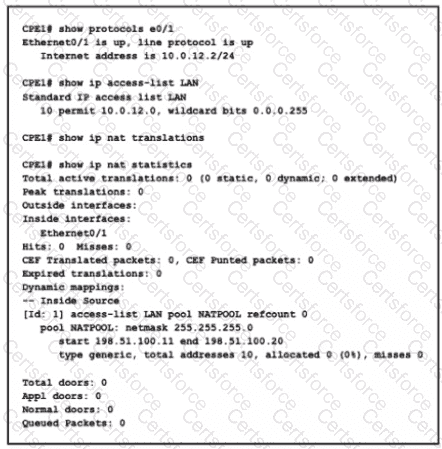
configure the NAT outside interface. IP services questions require matching the service to its exact operational role, such as logging, address assignment, file transfer, monitoring, redundancy, or traffic treatment. Cisco CCNA 200-301 v1.1 includes this under IP Services, where the expected skill is to identify the feature that actually creates the observed behavior or meets the configuration goal. The wording usually contains the decisive clue: a prefix length, a VLAN role, a protocol version, a wireless security standard, or a management-plane function. The distractors are real technologies, but they solve different infrastructure problems. In an operational network, choosing the wrong option would typically cause failed connectivity, insecure management, poor wireless behavior, or incorrect forwarding. The selected answer matches the Cisco configuration model and is retained as the verified answer.
Contribute your Thoughts:
Chosen Answer:
This is a voting comment (?). You can switch to a simple comment. It is better to Upvote an existing comment if you don't have anything to add.


Submit