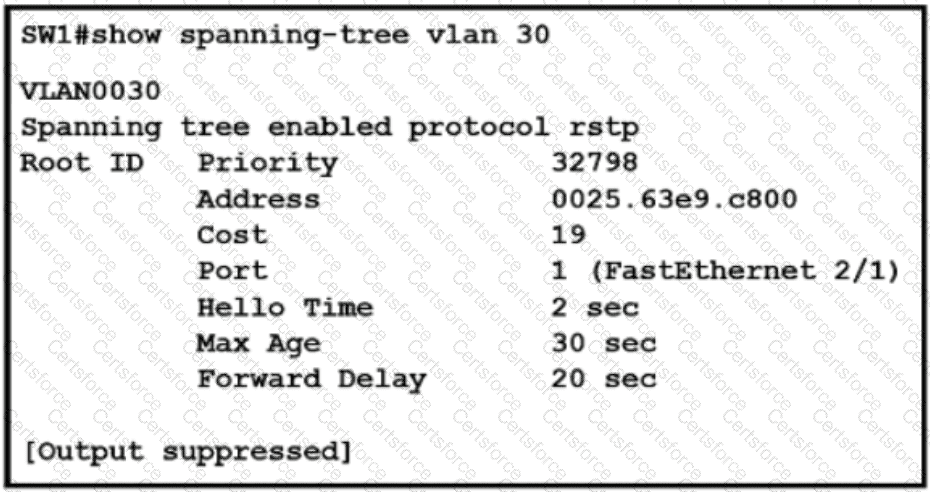
The exhibit indicates Rapid PVST+ operation and shows FastEthernet 2/1 as the root port. In spanning-tree output, the protocol mode tells you whether the switch is running classic PVST+ or the rapid variant. Rapid PVST+ is Cisco ' s per-VLAN implementation of 802.1w rapid spanning tree behavior, giving faster convergence than traditional 802.1D STP. The root port is the switch port with the lowest-cost path toward the root bridge. A non-root switch has one root port per spanning-tree instance; the root bridge itself has no root port. A designated port is selected per segment to forward traffic away from the root. Cisco CCNA 200-301 v1.1 Network Access expects engineers to identify root bridge, root port, designated port, and STP mode from show command output. Since the output identifies Rapid PVST+ and FastEthernet 2/1 as the root-facing interface, C and E are the correct conclusions.
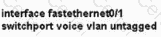
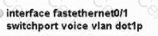
An engineer is configuring data and voice services to pass through the same port. The designated switch interface fastethernet0/1 must transmit packets using the same priority for data when they are received from the access port of the IP phone. Which configuration must be used?
A)
B)
C)
D)
A. Option A
B. Option B
C. Option C
D. Option D
Answer: A
Contribute your Thoughts:
Chosen Answer:
This is a voting comment (?). You can switch to a simple comment. It is better to Upvote an existing comment if you don't have anything to add.




Submit