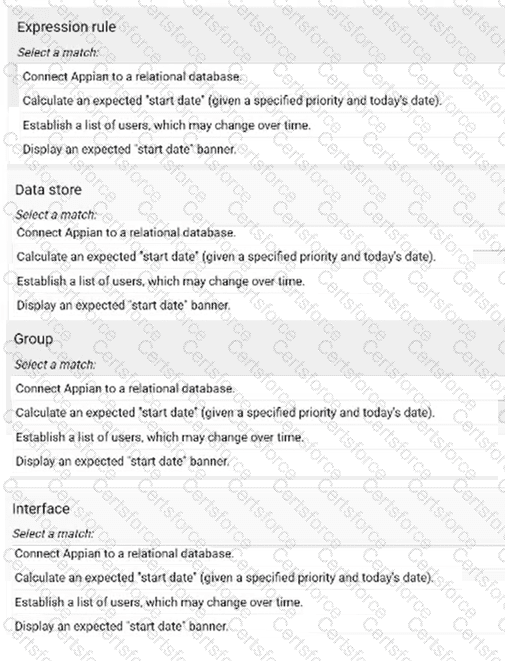
Expression Rule → Calculate an expected start date, given a specified priority and today’s date.
Data Store → Connect Appian to a relational database.
Group → Establish a list of users that may change over time.
Interface → Display an expected start-date banner.
Each mapping represents the primary responsibility of the Appian object. An expression rule encapsulates reusable business logic, so calculating a start date from priority and the current date belongs in an expression rule. A data store connects Appian to an external relational database and supports storing and retrieving application data. A group organizes users or other groups and can be maintained manually or through dynamic membership rules. An interface returns components that capture or display information to application users, making it appropriate for displaying a start-date banner. Separating calculation, persistence, user organization, and presentation into their appropriate object types improves reusability, maintainability, security, and adherence to Appian’s object-oriented application architecture.
Contribute your Thoughts:
Chosen Answer:
This is a voting comment (?). You can switch to a simple comment. It is better to Upvote an existing comment if you don't have anything to add.



Submit