
(What does the suffix-graphmean?)
(A patient is seen by her podiatrist to treat a painfulleft ingrown toenailon the big toe. The podiatrist performs awedge excisionof the skin of the nail fold at the lateral margin. Local anesthetic is administered, and an elliptical incision is made through subcutaneous tissue of the affected nail groove. A wedge-shaped piece of soft tissue from the nail margins is removed. What CPT® code is reported?)
A patient undergoes a percutaneous liver biopsy with ultrasound guidance for primary biliary cirrhosis.
What CPT® and ICD-10-CM codes are reported?
An inpatient, suffering from hypertension and chronic kidney disease, is administered continuous venovenous hemofiltration. The on-duty nephrologist performs a series repeated low-level evaluation and management services to monitor the patient ' s status.
What is the CPT® and ICD-10-CM coding '
A 67-year-old patient has osteomyelitis of the shoulder blade and is in surgery to remove the sequestered section of dead infected fragment bone from surrounding bone.
What CPT® code is reported?
Preoperative diagnosis: Right thigh benign congenital hairy nevus. *1
Postoperative diagnosis: Right thigh benign congenital hairy 0 nevus.
Operation performed: Excision of right thigh benign congenital > 1
nevus, excision size with margins 4.5 cm and closure size 5 cm.
Anesthesia: General.0
Intraoperative antibiotics: Ancef.0
Indications: The patient is a 5-year-old girl who presented with her parents for evaluation of her right thigh congenital nevus. It has been followed by pediatrics and thought to have changed over the past year. Family requested excision. They understood the risks involved, which included but were not limited to risks of general
anesthesia, infection, bleeding, wound dehiscence, and poor scar formation. They understood the scar would likely widen as the child grows because of the location of it and because of the age of the patient. They consented to proceed.
Description of procedure: The patient was seen preoperatively in > I the holding area, identified, and then brought to the operating room. Once adequate general anesthesia had been induced, the patient ' s right thigh was prepped and draped in standard surgical fashion. An elliptical excision measuring 6 x 1.8 cm had been marked. This was injected with Lidocaine with epinephrine, total of 6 cc of 1% with 1:100,000. After an adequate amount of time, a #15 blade was used to sharply excise this full thickness.
This was passed to pathology for review. The wound required □ limited undermining in the deep subcutaneous plane on both sides for approximately 1.5 cm in order to allow mobilization of the skin for closure. The skin was then closed in a layered fashion using 3-0 Vicryl on the dermis and then 4-0 Monocryl running subcuticular in the skin, the wound was cleaned and dressed with Dermabond and Steri-Strips.
The patient was then cleaned and turned over to anesthesia for S extubation.
She was extubated successfully in the operating room and taken S to the recovery room in stable condition. There were no complications.
Which CPT® and ICD-10-CM codes are reported for this procedure?
A patient comes to the gynecologist ' s office to check if she is pregnant. A urine sample is taken and tested. The visual result is positive that she is pregnant.
What CPT® code is reported '
What CPT® coding is reported for a subtotal thyroidectomy for malignancy with radical neck dissection?
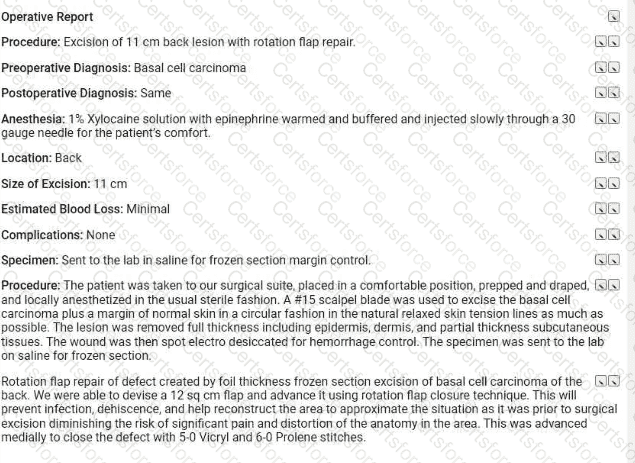
Refer to the supplemental information when answering this question:
View MR 623654
What CPTO coding is reported for this case?
A patient is going to have placement of a myringotomy tube. This tube is placed in the ______ to drain excess fluid.
