New Year Sale Limited Time 70% Discount Offer - Ends in 0d 00h 00m 00s - Coupon code: simple70

Pass the Fortinet Fortinet Certified Professional Public Cloud Security FCP_ZCS_AD-7.4 Questions and answers with CertsForce

Viewing page 1 out of 1 pages
Viewing questions 1-10 out of questions
Questions # 1:

Your organization is in the process of optimizing its Azure network architecture and wants to dynamically manage and exchange routing information between its virtual networks and on-premises networks.

Which Azure service would help to provide a centralized point for efficient route management and dynamic routing?

Options:

A.

Azure Virtual WAN


B.

Azure VPN Gateway


C.

Azure ExpressRoute


D.

Azure Route Server


Expert Solution
Questions # 2:

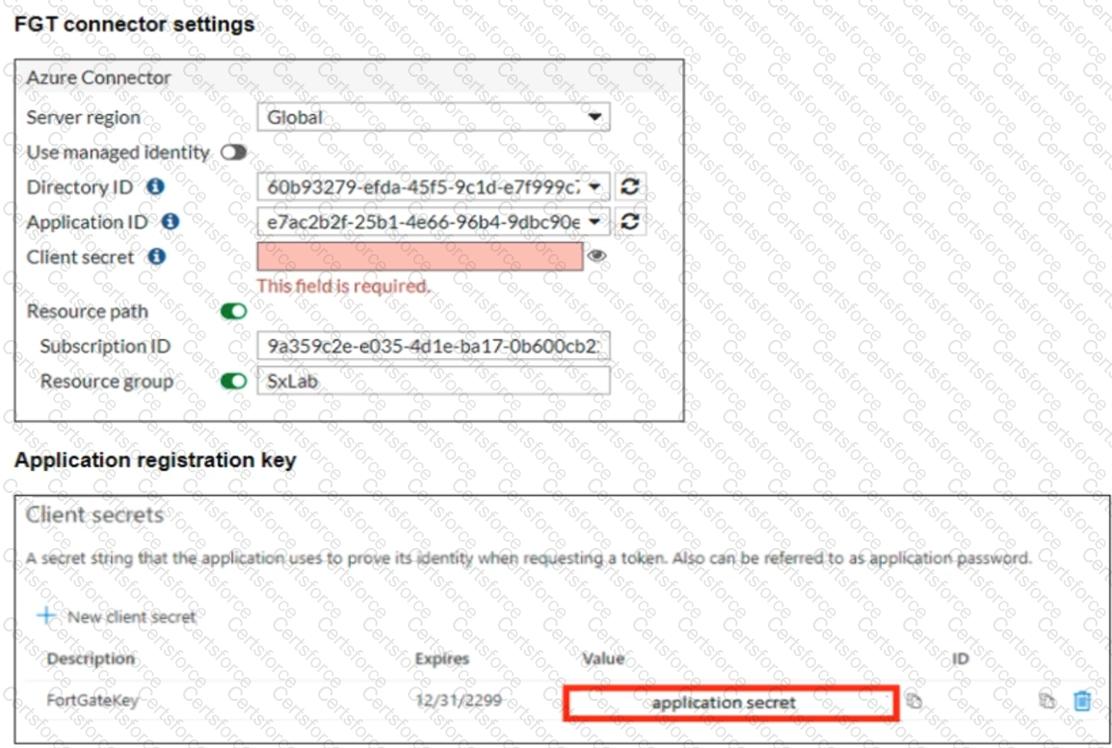
Refer to the exhibits.

Question # 2

You are configuring an SDN connector for Azure on a FortiGate device You completed all the required steps on the Azure side. While configuring the FortiGate side, you notice that you did not save the client secret used in the Azure App Registration.

What is the quickest way to obtain the value of the client secret?

Options:

A.

Create a new resource group


B.

Create a new client secret


C.

Create a new app registration


D.

Create a new external connector for Azure


Expert Solution
Questions # 3:

Which statement about deploying VMs in a gateway subnet is true?

Options:

A.

VMs are not allowed in a gateway subnet


B.

VMs can be deployed in a gateway subnet only after you deploy the VPN Gateway


C.

VMs are required in a gateway subnet


D.

VMs are automatically deployed in a gateway subnet


Expert Solution
Questions # 4:

Why would you use a user-defined route in Azure?

Options:

A.

To manage user authentication and access control


B.

To have the traffic from the other VMs inspected by FortiGate


C.

To allow inbound management access to FortiGate VMs


D.

To allow communication between FortiGate VMs on two subnets in the same VNET


Expert Solution
Questions # 5:

What characterizes the branch-to-branch topology in an Azure virtual WAN?

Options:

A.

Increased redundancy through multiple connections to the central hub


B.

Enhanced security through centralized traffic management


C.

Simplified network architecture with reduced hub dependencies


D.

Improved scalability for branch offices connecting to Azure


Expert Solution
Questions # 6:

When you deploy a single FortiGate VM using the available template from the Azure Marketplace, several other resources are also created.

Which two resources, among others, are created during the process? (Choose two.)

Options:

A.

Two virtual NICs


B.

One NSG for each interface


C.

One VM Scale set


D.

One new route table


Expert Solution
Questions # 7:

What is a key distinction between Azure Firewall and FortiGate VM in terms of their primary functions?

Options:

A.

Azure Firewall is a cloud-native network security service, while FortiGate VM is a network virtual appliance (NVA) that provides comprehensive security functions.


B.

Azure Firewall focuses on network traffic inspection, while FortiGate VM is primarily a web application firewall.


C.

Azure Firewall is designed exclusively for application layer filtering, while FortiGate VM is suitable for both on-premises and cloud environments.


D.

Azure Firewall and FortiGate VM have identical primary functions, and no features differentiation.


Expert Solution
Questions # 8:

You deployed a FortiGate active-active with ELB/ILB solution using the template from Azure Marketplace.

What is the purpose of the inbound NAT rules configured in the external load balancer in this deployment?

Options:

A.

To load balance the incoming traffic between both FortiGate VMs


B.

To filter inbound traffic before it reaches the FortiGate instances


C.

To forward the health probes to both FortiGate VMs


D.

To allow administrative access to the FortiGate VMs


Expert Solution
Questions # 9:

Refer to the exhibit.

Question # 9

In an expanding corporation, the different branches share resources connecting to Azure through Azure VPN Gateway and ExpressRoute Gateway.

Which Azure solution can you implement to simplify and centralize the seamless sharing of the dynamic routing between FortiGate VMs and branches?

Options:

A.

Azure Route Server


B.

Azure Traffic Manager


C.

Azure Virtual Hub


D.

Azure Virtual WAN


Expert Solution
Questions # 10:

How are the configurations synchronized between two FortiGate VMs in an active-passive HA with SDN connector failover deployed from the Azure marketplace?

Options:

A.

Using unicast FGCP


B.

Using system autoscaling during a failover


C.

An Azure function distributes the configuration files


D.

By configuring FGSP on the primary


Expert Solution
Viewing page 1 out of 1 pages
Viewing questions 1-10 out of questions