Comprehensive and Detailed Explanation From Exact Extract (150–250 words):
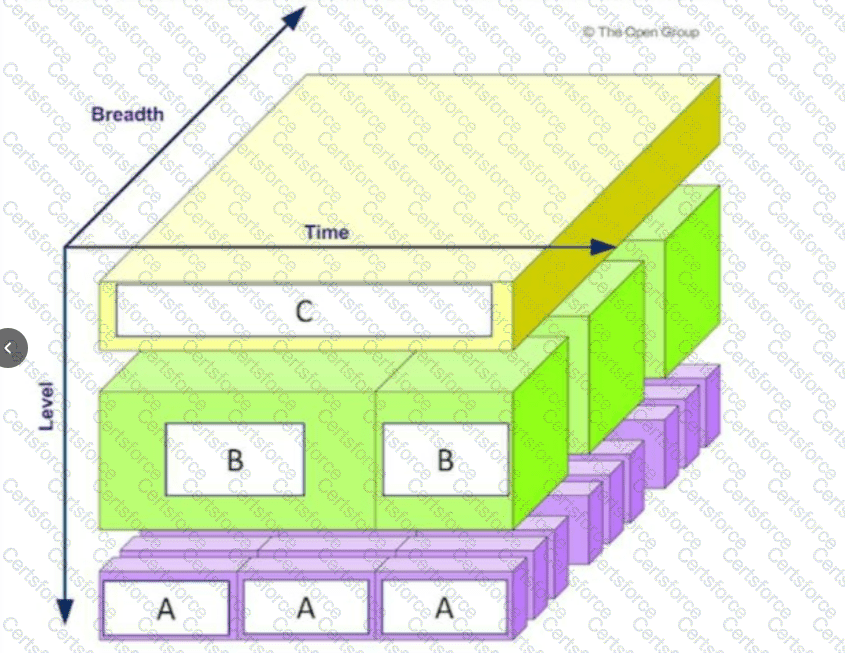
In TOGAF, the Architecture Landscape is classified across three levels: Strategic, Segment, and Capability. These levels represent increasing detail and decreasing scope as you move downward through the model.
The top level (C) represents the Enterprise Strategic Architecture. This level provides a broad, long-term view of the enterprise, aligned with business strategy and covering the entire organization. It defines the overall direction, policies, and high-level structure of the enterprise architecture.
The middle level (B) represents the Segment Architecture. This level focuses on specific business segments, divisions, or domains within the enterprise. It translates strategic intent into more detailed architectural guidance relevant to particular areas of the organization.
The bottom level (A) represents the Capability Architecture, which is the most detailed level, focusing on specific capabilities and implementation concerns.
Given this structure:
C corresponds to Enterprise Strategic Architecture (1)
B corresponds to Segment Architecture (2)
Thus, the correct mapping is B-2, C-1, which is Option D.
This reflects TOGAF’s hierarchical approach where strategic architecture guides segment architecture, which in turn guides capability-level implementations.
===========


Submit