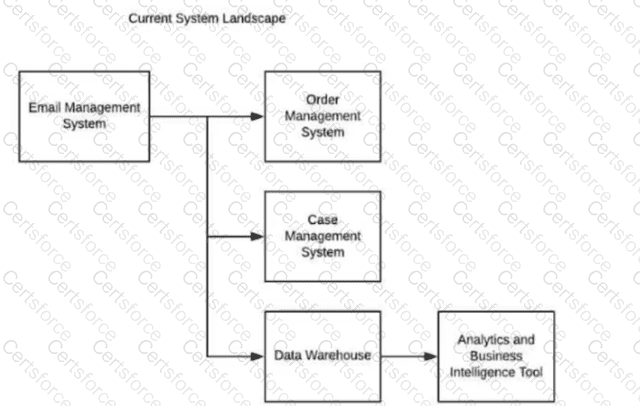
When evaluating a current system landscape for a Salesforce implementation, an Integration Architect’s primary goal is to align the platform’s native capabilities with the existing architecture to determine which systems will be replaced, retired, or integrated. Based on the provided diagram (image_69c0fd.png), the landscape consists of an Email Management System, an Order Management System, a Case Management System, and a Data Warehouse used for Business Intelligence.
In a scenario where an enterprise is implementing Salesforce to support Case Management (Service Cloud), Salesforce natively provides the robust capabilities required to serve as the new "System of Record" for customer support interactions. Consequently, the legacy Case Management System is typically targeted for retirement. The architect’s evaluation therefore focuses on the necessary integration points with the systems that will coexist with the new Salesforce instance to ensure a unified agent experience.
As outlined in standard Salesforce Integration Architecture frameworks, the following evaluations are critical:
Order Management System (OMS): Salesforce must integrate with the OMS so that service agents can view real-time order history, shipping status, and line items directly within the Case record, often using patterns like Request-Reply or Data Virtualization.
Email Management System (EMS): To support Omni-Channel service, Salesforce needs to integrate with the EMS (via Email-to-Case or a Marketing Cloud connector) to ensure that all customer communications are captured and tracked against the appropriate Case records.
Data Warehouse: For long-term historical reporting and cross-functional analytics, Salesforce must push its transactional data to the enterprise Data Warehouse. This ensures the Analytics and Business Intelligence Tool can continue to provide a holistic view of company performance.
By selecting Option C, the architect recognizes that Salesforce replaces the legacy case management function while requiring strategic integration with the Data Warehouse, Order Management, and Email Management systems to achieve a true 360-degree view of the customer.


Submit