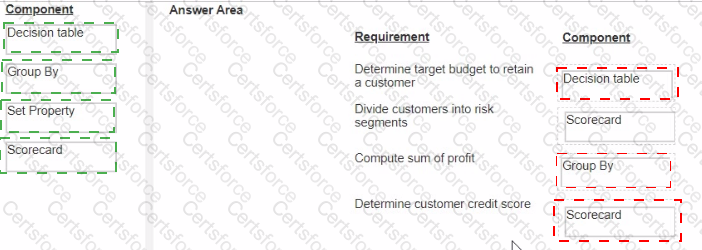
For matching the requirements with the correct components, the answers are as follows:
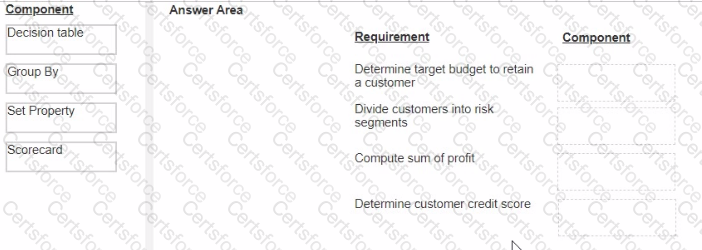
Determine target budget to retain a customer
Component: Decision table
Explanation: A decision table is used to define and evaluate multiple conditions to determine outcomes, such as calculating a target budget based on various customer attributes.
Divide customers into risk segments
Component: Scorecard
Explanation: A scorecard assesses and scores customer attributes to classify them into different risk segments, such as low, medium, or high risk.
Compute sum of profit
Component: Group By
Explanation: The Group By component aggregates data to compute sums, averages, and other statistics, such as the sum of profit across customer segments.
Determine customer credit score
Step by Step Comprehensive Detailed Explanation with References:
[Reference: Pega documentation on decision tables highlights their use in scenarios where multiple conditions need to be evaluated to determine an outcome., Scorecard:, Use Case: Scorecards are ideal for scoring and classifying customers based on predefined criteria, such as risk levels or credit scores., Reference: Pega's best practices for scorecards describe their use in assessing and categorizing customers based on various attributes., Group By:, Use Case: The Group By component aggregates data to compute totals, averages, and other summary statistics, making it suitable for calculating the sum of profit., Reference: Pega's guidelines on data aggregation components detail how Group By is used to summarize data across different dimensions., Set Property:, Use Case: Set Property is used to assign values to properties in a strategy, but it is not suitable for the requirements listed. Therefore, it is not matched with any requirement in this context., References: Pega's documentation on decision strategies provides detailed explanations on when and how to use decision tables, scorecards, and Group By components to meet various business requirements., , , , ]


Submit