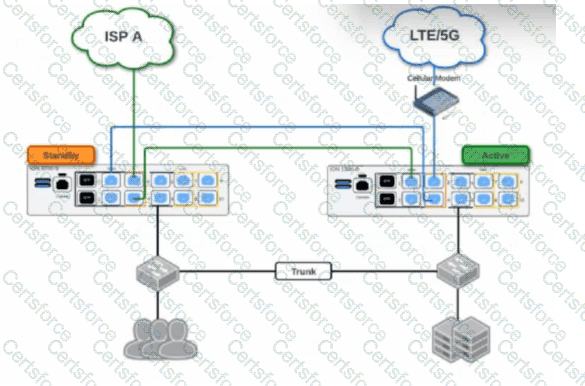
Based on the HA topology image below, which two statements describe the end-state when power is removed from the ION 1200-S labeled “Active”, assuming that the ION labeled “Standby” becomes the active ION? (Choose two.)
A.
Both the connection to ISP A and the connection to LTE/5G will be usable.
B.
The VRRP Virtual IP address assigned to any SVIs will be moved to the newly active ION.
C.
The newly active ION will send a gratuitous ARP to the LAN for the IP address of any SVIs.
D.
The connection to ISP A will be usable, but the connection to LTE/5G will not.
Prisma SD-WAN High Availability (HA) for branch ION devices, particularly the Gen-2 ION 1200-S, is designed to provide "100% WAN Capacity" preservation during a hardware or power failure. This is achieved through the use of Bypass Pairs (Fail-to-Wire). In the provided topology, the ISP A and LTE/5G circuits are cross-connected using the bypass ports (typically ports 3 and 4 on the ION 1200-S).
When the "Active" ION device loses power, the internal physical relays in its bypass ports transition to a closed state, effectively creating a physical bridge between the ports. In this scenario, the LTE/5G signal—which enters the Active ION's port 4—is mechanically bridged to port 3, allowing it to pass through to port 4 of the Standby ION. Simultaneously, ISP A is already connected to the Standby ION. Consequently, once the Standby device completes its transition to the "Active" state, it has physical access to both WAN circuits, validating Statement A.
Regarding the LAN transition, Prisma SD-WAN does not use standard VRRP for ION-to-ION HA; instead, it uses a proprietary Control Plane HA mechanism. When the failover occurs, the newly active ION takes over the IP addresses of all configured Switch Virtual Interfaces (SVIs) and LAN interfaces. To ensure the downstream Layer 2 infrastructure (like the LAN switches shown in the diagram) updates its MAC address tables to point to the new physical hardware for those IPs, the newly active ION immediately broadcasts a Gratuitous ARP (GARP). This ensures that LAN traffic is correctly steered to the new device without a significant timeout, validating Statement C.
Contribute your Thoughts:
Chosen Answer:
This is a voting comment (?). You can switch to a simple comment. It is better to Upvote an existing comment if you don't have anything to add.


Submit