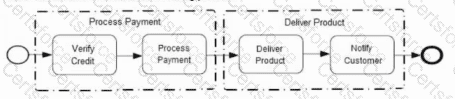
InBPMN, a rounded rectangle with adashed borderaround activities is aGroupartifact.
Key BPMN semantics for aGroup:
It ispurely documentary: used to visually group related activities (for example, labeling them “Process Payment” or “Deliver Product”).
Itdoes not affect execution semantics—sequence flow, data flow, and transaction behavior areexactly the same as if the group were not drawn.
Looking at the diagram:
The sequence is:Verify Credit → Process Payment → Deliver Product → Notify Customer, each connected by normal sequence flows.
The two dashed rectangles just visually cluster the first two and last two activities; there are no special events or gateways.
Now the options:
A. Activities that are in the dashed rectangle must exchange data.BPMN Groups say nothing about data exchange; this is incorrect.
B. The activities are executed as if the dashed rectangles do not exist.This matches the BPMN definition of a Group artifact and is correct.
C. Canceling "Notify Customer" will cancel the result of "Deliver Product".That would require atransaction subprocess with cancel behavior, not just a Group.
D. "Verify Credit" and "Process Payment" are executed in parallel. "Deliver Product" and "Notify Customer" are executed in parallel.Parallelism requires a parallel gateway or similar construct; here, a simple sequence flow shows they are executedsequentially.
Therefore, the correct statement is that thedashed rectangles have no execution effect: optionB.
Contribute your Thoughts:
Chosen Answer:
This is a voting comment (?). You can switch to a simple comment. It is better to Upvote an existing comment if you don't have anything to add.


Submit