Comprehensive and Detailed Explanation From Exact Extract–Based NCC C-EFM References:
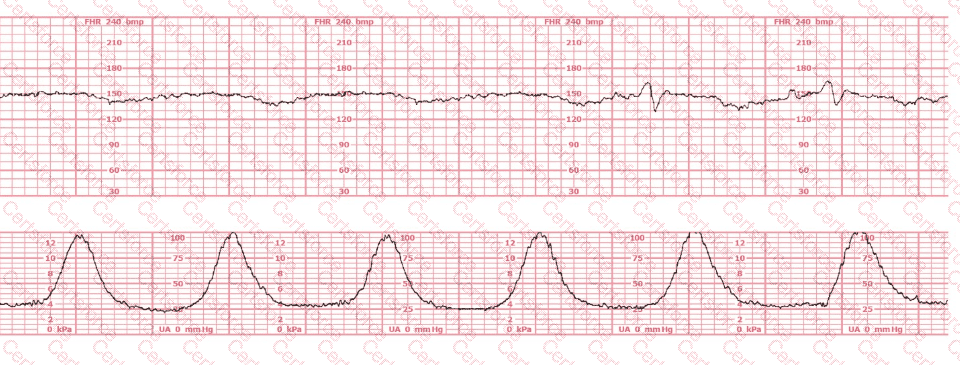
This tracing demonstrates:
A sudden prolonged deceleration following epidural placement
Minimal variability during the deceleration
Event occurring within 15 minutes of epidural
NCC, AWHONN, and Menihan emphasize that maternal hypotension is the most common complication immediately following epidural analgesia. Hypotension leads to:
Reduced uteroplacental perfusion
Fetal bradycardia or prolonged decelerations
Decreased variability during the deceleration
Typical fetal response to maternal hypotension:
Late-like or prolonged deceleration with weakening variability, exactly like the strip shown.
Therefore, the FIRST and most critical step is to check maternal blood pressure.
Other options:
B. Continue to monitor — unsafe when a prolonged deceleration is present.
C. Cervical exam — not indicated; the fetal tracing deterioration is temporally linked to epidural placement.
Thus, the correct action is A. Check maternal blood pressure.
[References:NCC C-EFM Candidate Guide; AWHONN Fetal Heart Monitoring Principles & Practices; Menihan Electronic Fetal Monitoring; Miller’s Fetal Monitoring Pocket Guide; Creasy & Resnik Maternal–Fetal Medicine., ]


Submit