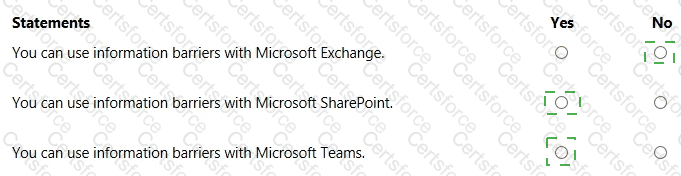
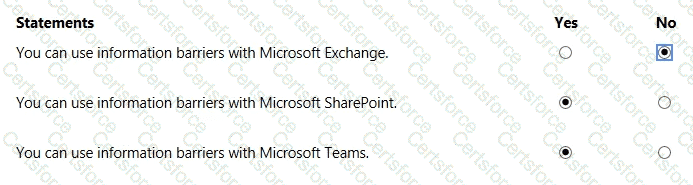
Microsoft defines Information Barriers (IB) as policies that “restrict communication and collaboration between specific users or groups” to meet regulatory or conflict-of-interest requirements. In Microsoft 365, IB enforcement is provided across collaboration workloads—most notably Microsoft Teams and, with IB v2, SharePoint and OneDrive—so that users placed in segments that shouldn’t interact are prevented from chatting, meeting, or sharing files with one another. The service “controls who can communicate and collaborate with whom” and applies those controls to Teams chats/channels and SharePoint/OneDrive sites and files so that segment boundaries are honored when users attempt to share or access content.
By contrast, Exchange Online email is not a supported enforcement surface for Information Barriers; IB does not block or route mail. Email restrictions are handled with other capabilities (for example, mail flow rules), not IB. Therefore, in alignment with Microsoft’s SCI guidance: IB does work with Microsoft Teams and with Microsoft SharePoint/OneDrive, but it does not provide policy enforcement for Exchange email.
Contribute your Thoughts:
Chosen Answer:
This is a voting comment (?). You can switch to a simple comment. It is better to Upvote an existing comment if you don't have anything to add.



Submit