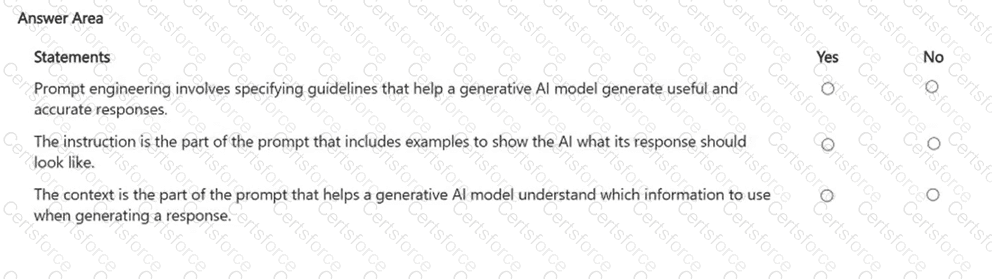
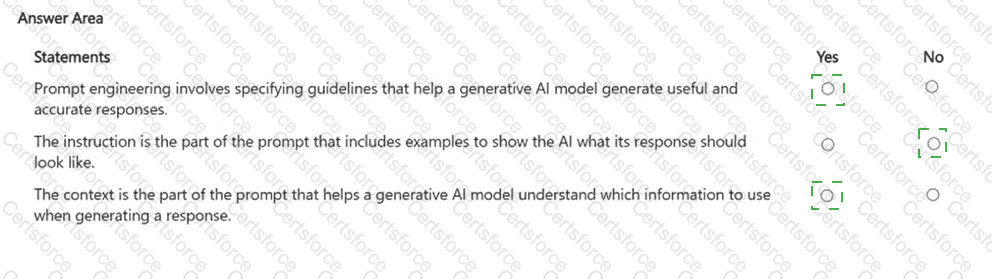
The correct selections are Yes, No, Yes. Prompt engineering is the practice of designing clear and effective inputs that guide a generative AI model toward relevant, accurate, and useful output. Guidelines, constraints, role instructions, tone requirements, and output-format rules are all common prompt-engineering techniques, so statement A is true. Statement B is false because examples are normally considered examples or few-shot demonstrations, not the instruction itself. The instruction tells the model what task to perform, while examples demonstrate the preferred pattern or output style. Statement C is true because context supplies the background information, source material, business scenario, audience, or constraints the model should use when generating the answer. Strong prompts usually combine instruction, context, constraints, and examples.
Contribute your Thoughts:
Chosen Answer:
This is a voting comment (?). You can switch to a simple comment. It is better to Upvote an existing comment if you don't have anything to add.



Submit