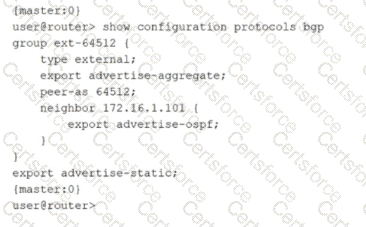
In Junos BGP configuration, export policy can be applied at multiple levels, including the BGP group level and the individual neighbor level. When an export policy is configured directly under a specific neighbor, that policy is explicitly associated with advertisements sent to that neighbor and is therefore the policy that applies to that neighbor. In the exhibit, neighbor 172.16.1.101 has an export statement configured within the neighbor stanza, and that statement references the advertise-ospf policy. This is the most specific policy attachment in the configuration because it is tied to a single peer rather than to the entire group or the whole BGP process.
Group-level export policies, such as advertise-aggregate configured under the group, apply broadly to all neighbors in that group unless a neighbor has additional neighbor-specific policy. A BGP-level export policy configured outside the group applies as a more general export policy scope. However, the question asks which export policy applies to the specific neighbor, and the correct selection is the neighbor-specific export policy that is explicitly configured for that peer.
Operationally, this allows data center engineers to advertise different route sets to different peers, for example exporting OSPF-derived infrastructure routes to one neighbor while exporting aggregates or static routes to another, all while keeping a consistent group template for shared settings such as peer AS and session type.
Contribute your Thoughts:
Chosen Answer:
This is a voting comment (?). You can switch to a simple comment. It is better to Upvote an existing comment if you don't have anything to add.


Submit