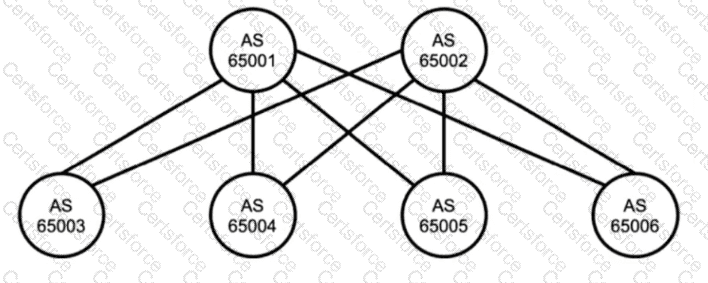
The diagram shows multiple autonomous systems, with each device labeled with a different AS number. Because the peers are in different autonomous systems, the correct BGP session type is external BGP. In a typical Juniper data center IP fabric underlay, this design is intentional: EBGP is used between leaf and spine devices to simplify policy boundaries, improve operational clarity, and avoid the additional mechanisms commonly required in large internal BGP designs.
In an EBGP-based underlay, neighbors are most commonly formed over the directly connected point-to-point links between leaf and spine. That means the BGP peering is established using the IP addresses configured on those physical routed interfaces, not loopback addresses. Using physically connected addresses aligns with the default EBGP behavior where the TTL is one hop, and it reduces configuration complexity because no multihop settings or additional reachability dependencies are required to bring up the session.
Peering using loopbacks is possible, but it typically requires EBGP multihop and a routing method to ensure reachability to the remote loopback before BGP can establish. That approach is more common for overlay control-plane sessions or for specific design requirements, rather than for the simplest and most common underlay implementation. Therefore, the two true statements are that the exhibit uses EBGP and that devices should peer using physically connected IP addresses.
Contribute your Thoughts:
Chosen Answer:
This is a voting comment (?). You can switch to a simple comment. It is better to Upvote an existing comment if you don't have anything to add.


Submit