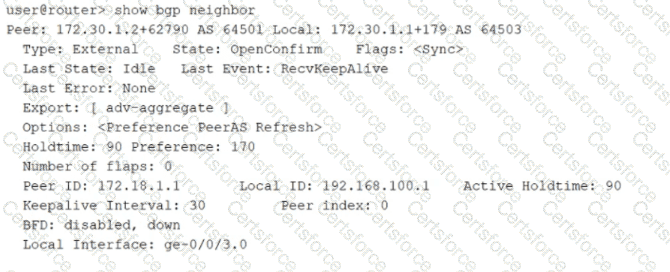
In the BGP finite state machine, OpenConfirm indicates that the TCP session is already established and the BGP OPEN message exchange has successfully completed. At this point, both peers have agreed on critical session parameters such as BGP version, autonomous system numbers, hold time, and the BGP identifier. Because the OPEN messages have been processed, BGP transitions from OpenSent to OpenConfirm and then waits for the next control message that validates the session is operational.
Specifically, in OpenConfirm the local BGP process is waiting to receive a KEEPALIVE message from the neighbor, which confirms that the neighbor accepted the OPEN and is ready to bring the session to the Established state. If instead a NOTIFICATION message is received, it indicates an error condition and the session will be torn down. This is why option D is correct.
Option A describes OpenSent, where the router is waiting to receive an OPEN after sending its own OPEN. Option B aligns more closely with Connect, where BGP is still trying to complete the transport connection. Option C relates to Idle, where BGP waits for a start event or configuration to initiate the session. In data center BGP underlays and EVPN control planes, being stuck in OpenConfirm commonly points to policy mismatch, capability negotiation issues, or keepalive handling problems, rather than basic IP reachability.


Submit