Comprehensive and Detailed In-Depth Explanation:
1. Free Mobility in Huawei Campus Networks:
Free mobility allows users to move freely within a campus network while retaining their access rights and security policies. It leverages iMaster NCE-Campus as the controller to simplify the deployment and management of user policies.
2. Role of the Administrator:
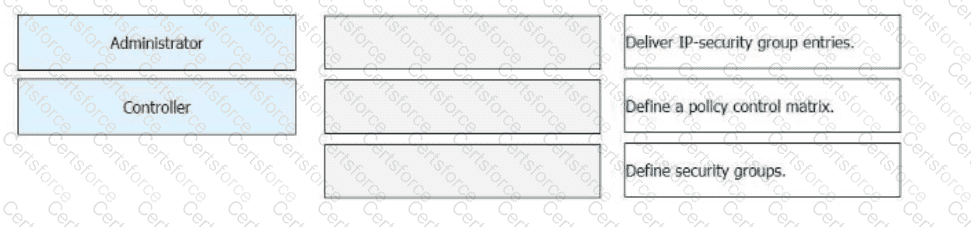
Administrators are responsible for defining high-level policies and security configurations. Specifically:
Define a Policy Control Matrix:
Administrators create a matrix that specifies how users from different security groups interact.
This matrix outlines access permissions and is a part of the policy planning phase.
Define Security Groups:
Administrators categorize users, devices, or endpoints into security groups based on their roles or functions.
These groups form the basis for applying uniform policies within the network.
3. Role of iMaster NCE-Campus (Controller):
The controller handles the automatic delivery of configured policies and security settings to network devices.
Deliver IP-Security Group Entries:
Once the administrator defines the policies and groups, iMaster NCE-Campus automatically distributes the IP-Security Group Binding entries to the relevant network devices.
This ensures consistent policy enforcement across the campus.
4. Why This Mapping Is Correct:
Administrators define the structure and policies, while the controller (iMaster NCE-Campus) handles the implementation and distribution.
This division of responsibilities optimizes the network management process, reducing human error and ensuring that policies are consistently applied.
[References:, Huawei HCIE-Datacom V1.0 Training Materials, Huawei iMaster NCE-Campus Configuration Guide, Huawei Free Mobility Solution Documentation, HCIE-Datacom Knowledge Base: Campus Network Mobility, , , , ]



Submit