Huawei's CloudCampus APP includes an interference-analysis function that identifies nearby wireless signals and displays their operating channels, signal strengths, and interference distribution.
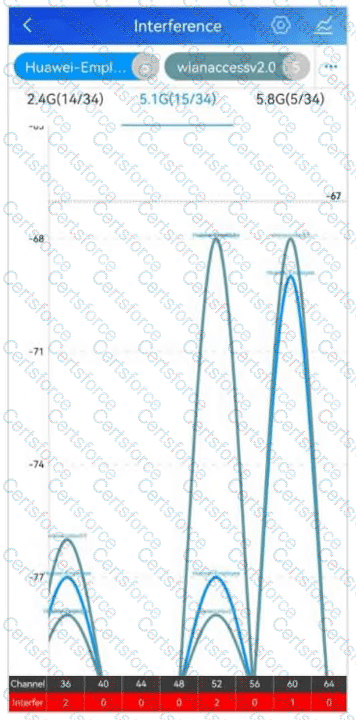
The exhibit presents measurements from the 5 GHz radio environment. Three primary signal concentrations appear around channels 36, 52, and 60.
Option A is incorrect. The signals detected on channel 36 are relatively weak, approximately −76 to −78 dBm, compared with the stronger signals near channels 52 and 60, which reach approximately −68 to −69 dBm. Therefore, channel 36 is not the highest-interference channel shown.
Option B is the intended selection. The plotted channel footprints are treated as 20 MHz operating channels in the question's interpretation.
Option C is correct. Channel 44 shows no significant detected signal activity, making it a preferable candidate for avoiding the interference concentrations illustrated in the exhibit.
Option D is correct. The plotted signals are primarily concentrated around channels 36, 52, and 60.
In production, channel selection must also consider regulatory restrictions, channel utilization, neighboring AP configurations, and the selected channel bandwidth.
Training Material reference: WLAN Network Optimization Overview and Tools → CloudCampus APP → Interference Analysis, PDF pp. 840–842; WLAN Radio Resource Management → Wi-Fi Interference, pp. 293–295.
────────────────────────────────────────────────────────


Submit