WLAN planning for indoor parking lots requires continuous wireless coverage along vehicle movement paths, entrances, exits, and areas where users or wireless-enabled equipment may move between coverage cells.
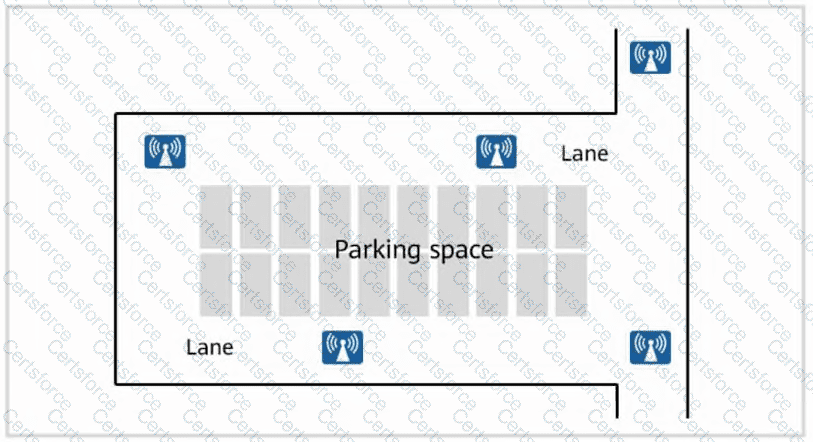
Huawei recommends deploying ceiling-mounted APs with omnidirectional antennas in a W-shaped arrangement, generally using an inter-AP spacing of approximately 35 m to 40 m.
AP positioning should follow the geometry of vehicle lanes rather than placing access points exclusively above parking spaces. This approach provides better coverage for moving terminals and reduces the likelihood of signal interruption during movement.
Additional APs should be considered where lanes connect to entrances, exits, or other critical movement paths. These locations are important because the wireless terminal may need to roam between APs while maintaining an active network connection.
The illustrated arrangement places APs along the internal lanes and near points where the vehicle movement paths connect, supporting continuous coverage across the parking area.
Huawei's planning guidance also emphasizes that AP positioning must account for obstacles and construction materials. Concrete columns, metal structures, and vehicles may affect signal propagation and produce localized coverage holes.
Therefore, deploying APs above lanes and at critical connecting points is consistent with the intended design principle.
Training Material reference: WLAN Planning Scenarios → WLAN Deployment Solution for Parking Lots, PDF pp. 542, 660 and 695.
Lab Guide reference: Lab 9 — Indoor WLAN Planning → AP Deployment Planning.
────────────────────────────────────────────────────────


Submit