Healthcare WLAN planning must account for the construction materials separating wards and consultation rooms because obstacle attenuation significantly affects achievable wireless coverage.
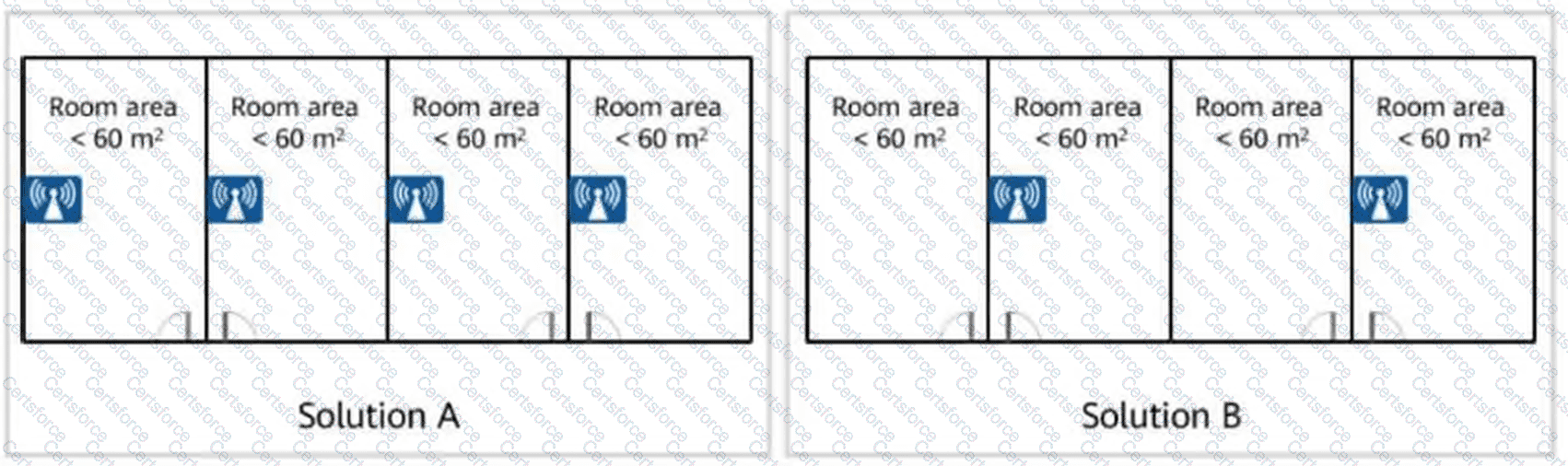
Huawei's Training Material presents two deployment solutions corresponding to different wall structures.
Solution A is intended for rooms separated by brick walls or other materials producing relatively high signal attenuation. In this arrangement, a wall-plate AP or agile distributed RU is installed in each room to provide independent wireless coverage.
The illustrated installation method is wall mounting. Therefore, option D is correct.
Solution B is intended for rooms separated by gypsum boards, foam partitions, or other materials with lower attenuation characteristics. In this arrangement, one AP or RU can cover two adjacent rooms.
The recommended installation method for Solution B is ceiling mounting, making option A correct.
Option B is incorrect because it identifies ceiling mounting rather than the wall-mounted installation shown for Solution A.
Option C is incorrect because it identifies wall mounting rather than ceiling mounting for Solution B.
Huawei additionally recommends positioning APs or RUs away from room doors to improve coverage distribution and reduce interference between adjacent coverage areas.
The correct selections are therefore A and D.
Training Material reference: WLAN Planning Scenarios → WLAN Planning in Healthcare Scenarios → WLAN Deployment Solution for Wards and Consulting Rooms, PDF p. 652, slide 25.
Lab Guide reference: Lab 9 — Indoor WLAN Planning → AP Placement and Coverage Design.
────────────────────────────────────────────────────────


Submit