Link speed
Correct transceiver form factor
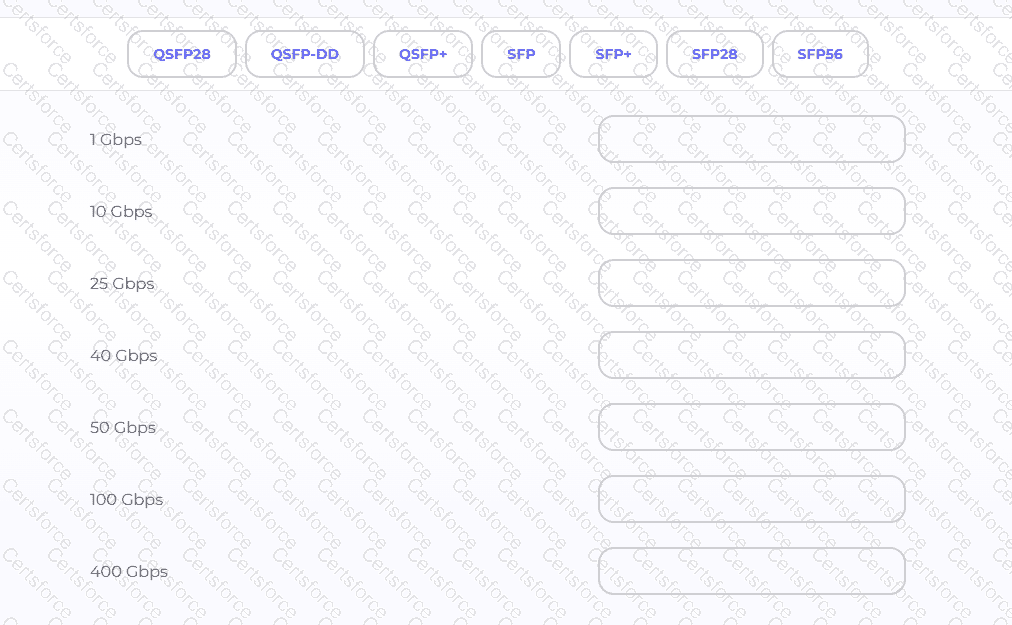
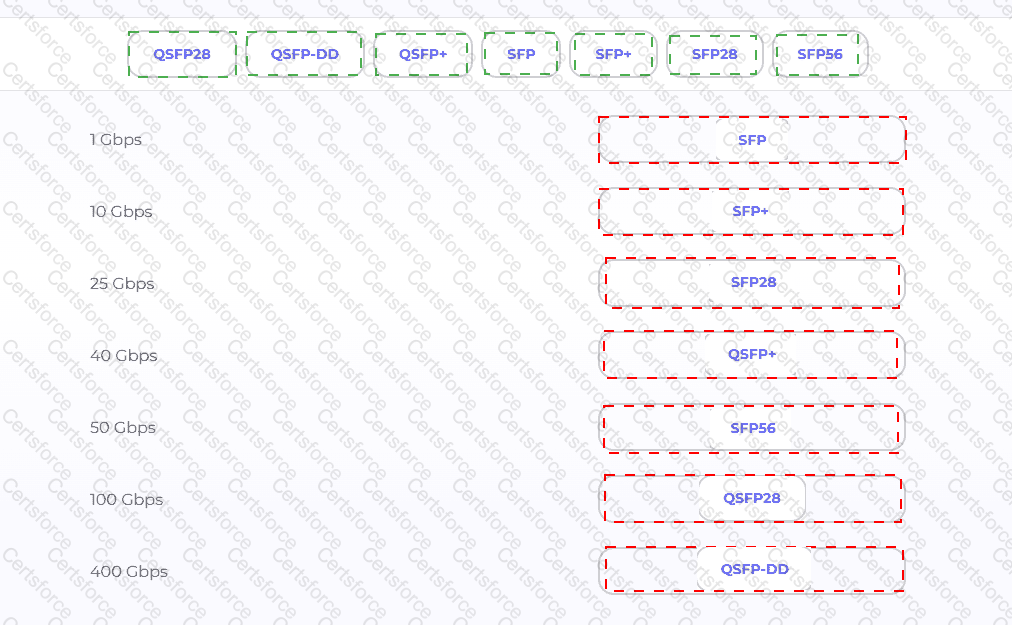
1 Gbps
SFP
10 Gbps
SFP+
25 Gbps
SFP28
40 Gbps
QSFP+
50 Gbps
SFP56
100 Gbps
QSFP28
400 Gbps
QSFP-DD
Optical transceiver form factors determine the physical interface, supported signaling technology, and nominal Ethernet speeds available for a network connection.
SFP transceivers are commonly associated with 1 GbE optical connectivity.
SFP+ extends the small form-factor pluggable architecture to support 10 GbE.
SFP28 provides a single-lane electrical interface commonly used for 25 GbE, while SFP56 supports 50 GbE through higher-speed signaling.
QSFP+ supports 40 GbE using four 10 Gbps lanes in common implementations.
QSFP28 supports 100 GbE, frequently using four 25 Gbps lanes, although other optical encoding methods are also available.
QSFP-DD provides additional electrical lanes and is commonly associated with 400 GbE connectivity.
The HPE Aruba Networking Transceiver Guide explicitly organizes optical products by these form factors and supported bandwidths.
However, physical connector type alone does not guarantee that a transceiver is compatible with a particular switch.
Some higher-speed interfaces support lower-speed modules or breakout configurations, while other interfaces impose platform-specific restrictions.
The architect must validate switch model, interface configuration, software release, optical reach, wavelength, fiber type, and transceiver compatibility before finalizing the bill of materials.
Official HPE Reference: HPE Aruba Networking AOS-S and AOS-CX Transceiver Guide — Optical Form Factors, Supported Speeds and Breakout Capabilities.
===============


Submit