Comprehensive and Detailed Explanation
HPE Press guide context | PDF page 567 | HPE Press, Aruba Certified Associate – Campus Access Official Certification Study Guide
Short exact extract: “The onboard device process starts at the device inventory.”
Technical Deep Dive — Original Chat Wording
Effective device management ensures that network infrastructure is registered, configured, monitored, and maintained according to organizational requirements.
HPE Aruba Networking Central provides a centralized management environment for supported switches, APs, and gateways.
During onboarding, administrators register devices, satisfy management-subscription requirements, and assign applicable configuration settings.
Once management is established, devices can receive the settings appropriate to their role in the network.
For example, a campus access switch may require user VLANs, 802.1X authentication, LACP uplinks, and PoE settings.
An aggregation switch may instead require Layer 3 routing, redundant uplinks, and different security controls.
Centralized management helps ensure that these distinct configurations are consistently deployed and maintained.
It also supports operational visibility, troubleshooting, and firmware lifecycle management.
However, the management process does not automatically back up user data stored on every connected endpoint.
Firmware automation is an available lifecycle capability, but updating every device on every occasion is neither the primary purpose nor universally appropriate.
Likewise, assigning an identical network role to every infrastructure device would ignore the different functions performed by access, aggregation, and core equipment.
The fundamental objective is to ensure each device is prepared for its intended operational purpose.
Therefore, Option A (It ensures each device is properly set up for use) is correct.
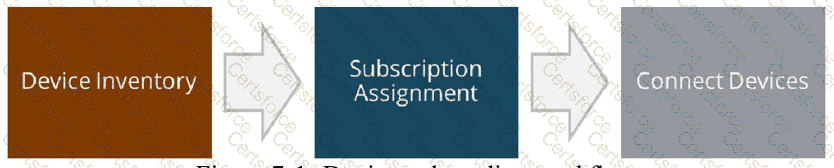
HPE Press study-guide figure / related learning illustration · Q157 Fig 7-1 Onboard


Submit