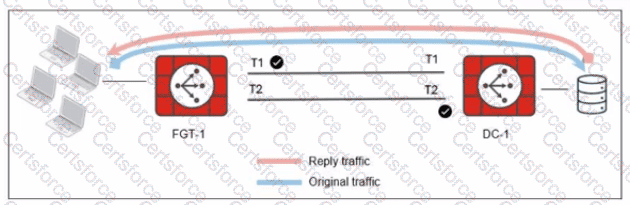
The exhibit shows the following IPsec phase1-interface configuration applied on spoke tunnels:
In the FCSS SD-WAN 7.6 ADVPN architecture, the network-overlay and network-id parameters are used to logically group IPsec tunnels into separate overlays. When network-overlay is enabled, FortiGate treats the tunnel as part of an overlay network rather than a simple transport tunnel.
The network-id parameter is critical in multi-overlay ADVPN designs. Fortinet documentation specifies that ADVPN shortcuts are only allowed between tunnels that share the same network-id. This mechanism explicitly prevents cross-overlay shortcuts, ensuring that shortcuts are formed only within the same logical overlay and not across different overlays that may serve different purposes (for example, different hubs, regions, or transport groups).
The use of auto-discovery-shortcuts dependent further enforces correct shortcut behavior by ensuring that shortcut tunnels depend on the state of the parent overlay tunnel, but it does not by itself prevent multiple shortcuts or convert ADVPN versions.
Why the other options are incorrect:
Option A is incorrect because simply enabling network-overlay does not exist to “enable overlay links” in general; its purpose is to define overlay membership and control shortcut behavior.
Option B is incorrect because there is no concept of “ADVPN 2.0” conversion using these parameters in FortiOS 7.6.
Option D is incorrect because preventing multiple shortcuts over the same overlay is not controlled by network-id; multiple shortcuts within the same overlay are allowed when required.
Therefore, the valid objective of these settings is to prevent cross-overlay shortcuts, which corresponds to Option C.
Submit